Canada has cut its EV tariff on Chinese-made vehicles in 2026. Here's what changed, who benefits, and how importers should adjust their sourcing strategy.
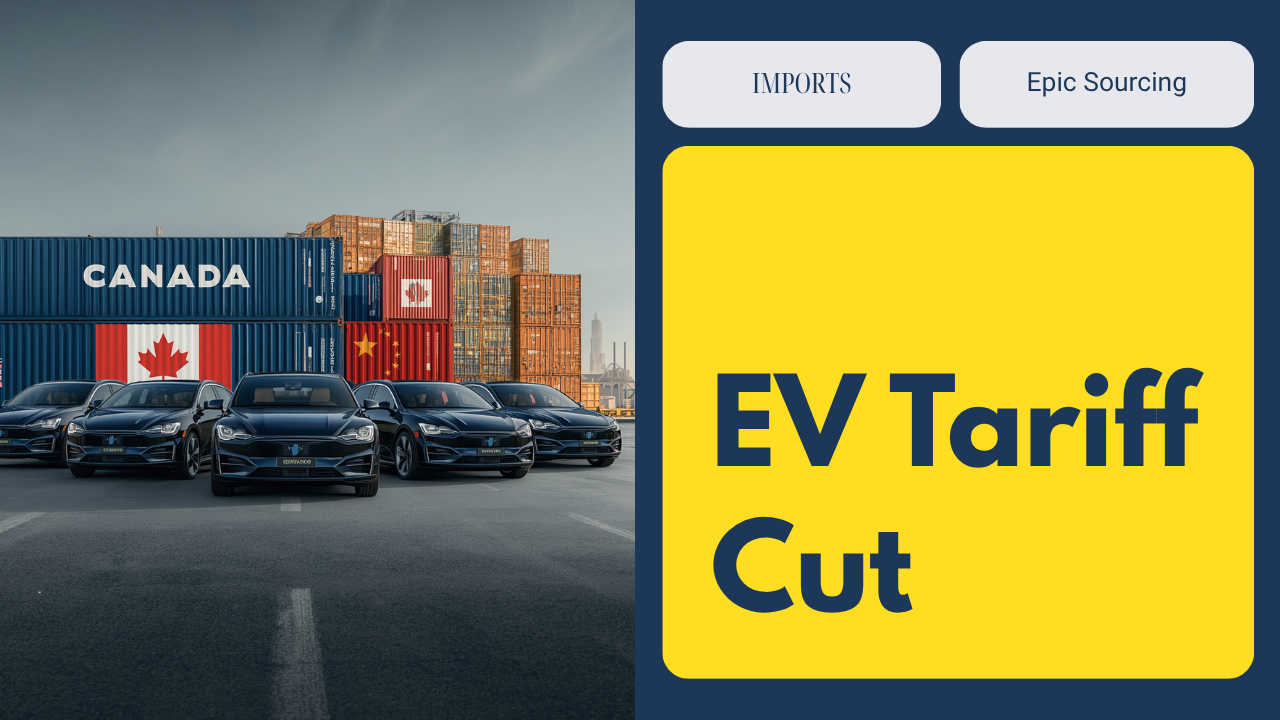
The Canada-China EV tariff relationship has been one of the more volatile corners of Canadian trade policy over the past two years, and 2026 has brought a meaningful shift. After Canada matched the US in imposing a 100% surtax on Chinese-made electric vehicles in 2024, ongoing negotiations have led to a partial rollback — a tariff cut aimed at easing pressure on Canadian consumers and businesses while trade talks between Ottawa and Beijing continue. For importers, this isn't just an EV story. It signals how Canada is recalibrating its broader trade posture with China, and that matters far beyond the automotive sector.
If your business imports EVs, EV components, batteries, or adjacent electronics from China, this tariff cut directly affects your landed cost. If you import anything else from China, it's still worth understanding — because it's a leading indicator of where Canada-China trade policy is headed next.
In 2024, Canada introduced a 100% tariff on Chinese electric vehicles, mirroring US trade action and citing concerns about state subsidies giving Chinese EV makers an unfair cost advantage. China responded with its own trade measures targeting Canadian canola and other agricultural exports, escalating tension between the two countries. Throughout 2025 and into 2026, both governments engaged in back-channel negotiations to de-escalate, given the economic cost to industries on both sides — Canadian farmers hurting from canola retaliation, and Canadian consumers facing higher EV prices at a time when affordability was already a political flashpoint.
The 2026 tariff cut is the visible result of that negotiation: a reduction (though not a full removal) of the EV surtax, paired with commitments on the Chinese side around canola and other agricultural trade. It's a partial thaw, not a full resolution — and Canadian importers should read it that way.
The direct impact is clearest for a few groups. EV importers and dealerships bringing in Chinese-made vehicles or those assembled with significant Chinese content see an immediate landed cost reduction, though likely still well above pre-2024 levels. Battery and EV component importers — for energy storage, e-bikes, and adjacent electronics that use similar battery cell technology — may see indirect benefits if the tariff cut signals a broader softening toward Chinese battery-related goods. And Canadian brands sourcing general electronics or smart home products from Chinese factories should watch this closely, since EV tariffs are often a bellwether for how Canada treats other Chinese-made technology categories.
If you're building or refreshing a smart home or electronics sourcing strategy, this tariff shift is a useful signal that the broader trade relationship may be easing, even if cautiously.
It's easy to read a tariff cut as a green light to source freely from China again. That would be premature. The surtax reduction doesn't undo the underlying trade tension — it's a negotiated concession, and negotiated concessions can be walked back if the broader relationship sours again. Canadian importers should treat this as an opportunity to improve margins, not as a signal to abandon supply chain diversification.
Documentation requirements haven't relaxed either. If anything, tariff changes like this tend to bring more scrutiny at the border as customs agencies adjust to new rates and verify that goods qualify for them. Getting your certificate of origin and supporting paperwork right is just as important under a reduced tariff as it was under the full one — arguably more so, since misclassified goods under a changing rate structure are an easy target for audit.
If this tariff reduction applies to your product category, there are a few concrete ways to capture the benefit rather than just noting it.
Recalculate your landed cost immediately. Don't assume the old tariff rate is still baked into your supplier quotes or your own pricing model — get an updated landed cost calculation done so you know your real margin under the new rate.
Revisit shelved sourcing decisions. If you previously ruled out a Chinese supplier for EV components or batteries because the 100% surtax made the numbers impossible, it may be worth re-running that comparison now that the rate has dropped.
Don't put all your eggs back in one basket. Even with a friendlier tariff environment, maintaining a secondary supplier relationship outside China remains sound risk management — this thaw could reverse if trade tensions resurface.
Check for anti-dumping overlap. Some EV-adjacent categories have separate anti-dumping duties layered on top of standard tariffs — a cut to the EV surtax doesn't necessarily touch those, so confirm your total duty stack rather than assuming one number covers everything.
Get your customs broker involved early. Tariff schedule changes create classification ambiguity in the transition period. A good customs broker can help you avoid delays while the new rate structure beds in.
Tariff percentages can feel abstract until you run them against a real order. Consider a Canadian EV dealership or fleet buyer importing a $35,000 CAD vehicle previously subject to the full 100% surtax — a duty cost of $35,000 on top of the vehicle price, effectively doubling landed cost. A meaningful cut to that surtax rate changes the math substantially: even a reduction to a much lower rate can mean tens of thousands of dollars in duty savings per unit, which flows straight through to either improved margins or a more competitive retail price. For a business bringing in dozens or hundreds of units a year, that's not a rounding error — it's the difference between a viable product line and one that doesn't pencil out.
The same logic applies at smaller scale to battery packs, EV charging components, and other categories that may see indirect benefit from a softening trade posture. The lesson isn't the specific dollar figure — it's that tariff changes this size are worth modelling precisely rather than reacting to the headline percentage alone. A rough mental estimate can easily be off by thousands of dollars per unit in either direction.
The EV tariff story isn't the first time Canadian importers have had to adjust to a fast-moving trade policy shift, and it won't be the last. Canadian steel and aluminum importers went through a similar cycle of surtax, negotiation, and partial rollback in previous years, and the businesses that came through it best shared a few habits: they diversified suppliers early rather than waiting for certainty, they kept detailed cost models updated in near real time rather than relying on last quarter's numbers, and they built direct relationships with their factories so they had first-hand information rather than relying solely on news coverage.
Canadian solar equipment importers dealt with something similar around anti-dumping measures on Chinese panels, where duty rates shifted meaningfully within a single year. Those who treated their sourcing strategy as a living document — revisited quarterly rather than set once and forgotten — adapted fastest. The EV tariff cut is a good prompt for any Chinese-sourcing importer, EV-related or not, to build that same habit into how they manage supplier relationships.
The EV tariff cut is a data point in a larger, still-unfolding negotiation. Canadian importers should keep an eye on how China follows through on its agricultural commitments, since any breakdown there could stall or reverse the EV concession. It's also worth watching whether Canada extends similar treatment to other Chinese-made technology categories, which would be a stronger signal of a genuine broader thaw rather than a narrow EV-specific deal. And with a US administration that has its own views on Chinese EV tariffs, any material shift in US policy could put renewed pressure on Canada to realign, given how closely Canadian and US trade postures toward China have moved together over the past two years.
For Canadian importers, the practical response to all of this uncertainty is the same regardless of which direction the news breaks next: keep your cost models current, keep your documentation clean, and keep more than one qualified supplier relationship active. That combination is what turns a volatile trade environment from a source of constant anxiety into a manageable, if occasionally annoying, part of doing business.
Before adjusting pricing, re-approaching a Chinese supplier, or restructuring an order, it's worth working through a short list of questions with your sourcing partner or customs broker. What exact HS code does your product fall under, and does the published tariff cut explicitly cover that code, or a related-but-different one? Is the reduced rate confirmed and in effect, or still working through a transition period where the old rate might still apply to goods already in transit? Does your existing supplier relationship have the capacity to scale back up if you're planning to shift more volume to China now that the surtax is lower? And critically, what is your contingency plan if this rate reverses within the next 12 to 18 months, given that it's a negotiated concession rather than settled policy?
Getting clear answers to these before committing to new purchase orders or long-term contracts avoids the common mistake of locking in decisions based on a tariff rate that may not hold, or that may not even apply to your specific product classification in the way the headline suggests.
Does the tariff cut apply to all Chinese EVs, or just certain models?
The reduction applies broadly to the EV surtax category, but specific eligibility can depend on vehicle classification and country-of-origin documentation, so it's worth confirming your exact HS code treatment rather than assuming a blanket rate.
Does this affect EV batteries and components separately from finished vehicles?
Batteries and components are often classified under different tariff codes than finished EVs, so the surtax cut may not automatically extend to every part of your supply chain — check classification carefully.
Is this tariff cut permanent?
It reflects the current state of an ongoing negotiation rather than a permanent policy change, so importers should build contingency plans in case rates shift again.
Should I switch back to Chinese suppliers now that tariffs are lower?
It's a reasonable time to re-run the numbers, but full reliance on one country still carries risk — a diversified supplier base remains the safer long-term strategy.
How do I find out if my specific product qualifies for the reduced rate?
Your customs broker or a sourcing partner familiar with current Canada-China trade schedules can confirm your product's classification and applicable rate.
Whether you're recalculating landed costs after this tariff cut, re-evaluating a Chinese EV or battery supplier, or just want a sourcing strategy that isn't derailed by the next trade policy swing, Epic Sourcing Canada can help. We track Canada-China trade developments closely and help Canadian brands build supplier relationships that stay resilient no matter which way the tariff winds blow. Reach out to our team to talk through what this tariff cut means for your specific product line.