Import duties on Chinese goods are one of the most misunderstood costs in Canadian importing. This guide breaks down exactly what you will pay in 2026 — including CBSA tariff rates, the 25% steel and aluminum surtax, how to calculate your landed cost, and what CARM means for your import account.
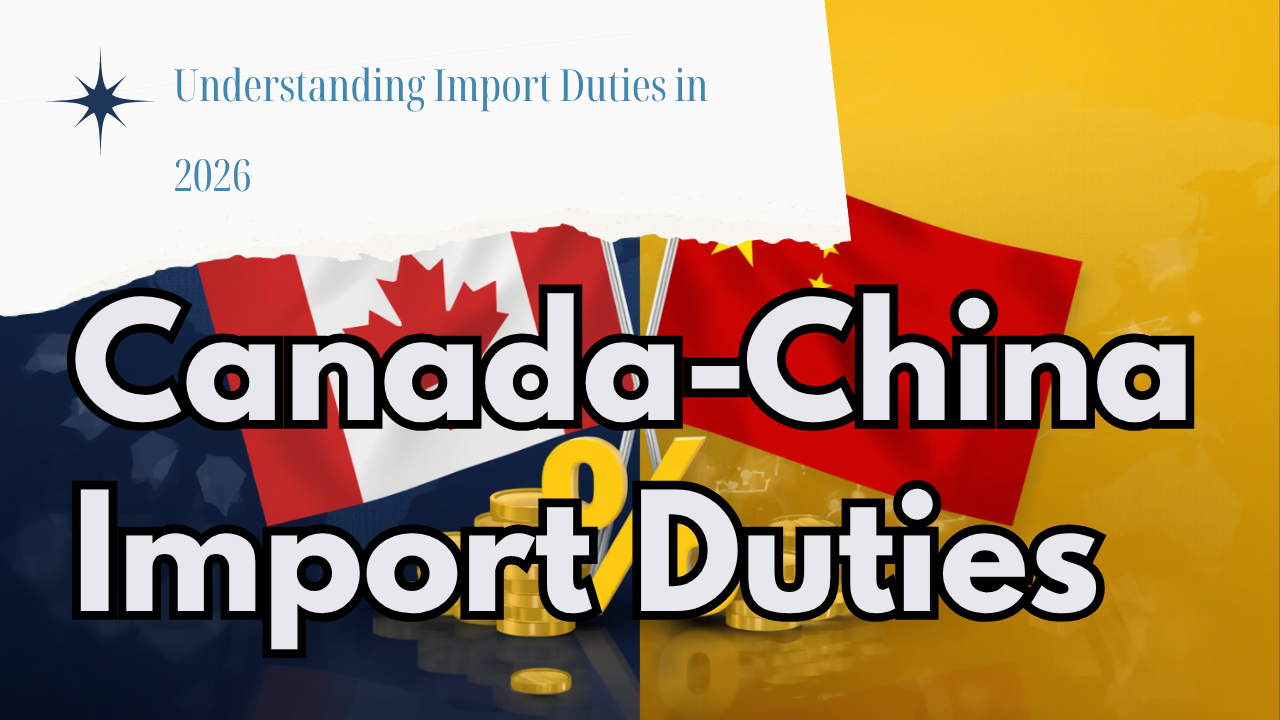
Import duties are one of the most underestimated costs in Canadian importing. Many first-time importers budget for the product price and ocean freight, then get a surprise bill from their customs broker when their goods clear CBSA. Understanding exactly what you will pay — before you place your order — is essential to protecting your margins.
This guide covers everything Canadian importers need to know about duties on Chinese goods in 2026: how tariff rates work, the 25 percent surtax on steel and aluminum, how to calculate your landed cost, and what the CARM portal means for your import compliance.
Every product imported into Canada is classified under the Harmonized System (HS), a globally standardised coding system that assigns a unique numerical code to every type of goods. Your HS tariff code determines your duty rate.
Canada's import duties are applied as a percentage of the customs value of your goods. The customs value is typically the transaction value — the price you actually paid your Chinese supplier — though it can also include certain assists such as tooling, moulds, or design work you paid for separately.
On top of the duty rate, all commercial imports into Canada are subject to 5 percent federal GST. Provincial sales tax (PST or QST) may also apply depending on the destination province and the product category. These taxes are calculated on the customs value plus duty, not just the product price.
For example, if you import $10,000 worth of goods from China at a 10 percent duty rate, you pay $1,000 in duty plus $550 in GST (5 percent of $11,000), for a total of $1,550 in government charges — before freight, brokerage, and port fees.
Canada's Most Favoured Nation (MFN) duty rates apply to goods from China, as China is a WTO member but not a Canada free trade agreement partner. MFN rates vary by product category.
Some common duty rates for Canadian importers sourcing from China: clothing and apparel typically attract 18 to 20 percent duty; footwear ranges from 11 to 20 percent; electronics and electrical equipment generally fall between 0 and 6 percent; furniture and home goods are typically 0 to 9.5 percent; plastics and rubber products range from 0 to 6.5 percent; and toys and sporting goods are generally 0 to 7 percent.
The only reliable way to know your exact duty rate is to identify your product's HS tariff code and look it up in Canada's Customs Tariff. Your customs broker can do this for you, or you can search the CBSA tariff schedule directly. This is worth doing before you commit to a supplier price — duty can represent a significant portion of your total landed cost.
In October 2024, Canada introduced a 25 percent surtax on a broad range of Chinese steel and aluminum products, following similar measures by the United States and the European Union. This surtax is applied on top of the standard MFN duty rate, meaning affected products now face substantially higher landed costs.
The surtax covers a wide range of HS tariff codes across steel and aluminum products including flat-rolled steel, structural steel, wire, tubes and pipes, aluminum sheet and foil, and many downstream fabricated metal products. If your product contains significant steel or aluminum content — including many types of industrial equipment, hardware, storage products, racking, and construction materials — your goods may be caught by this surtax even if the product itself is not purely a steel or aluminum item.
Before placing an order for any product with metal content, confirm with your customs broker whether the surtax applies to your specific HS code. Getting this wrong can turn a profitable order into a loss.
One duty cost that catches many Canadian importers off guard is the treatment of assists in the customs valuation of your goods.
An assist is any item, service, or intellectual property that you supply free or at a reduced cost to your supplier for use in the production of your goods. The most common example is tooling and moulds. If you paid $5,000 for a custom mould for your product, CBSA requires that the cost of the mould be added to the customs value of the goods produced using it, prorated across the production run.
Other assists include packaging materials you supply, engineering drawings or designs you provide to the factory, and raw materials you send to the supplier. Failing to declare assists correctly is a CBSA compliance risk that can result in penalties, back-duty assessments, and interest charges. Always disclose assists to your customs broker.
Landed cost is the total cost of getting your product from the Chinese factory to your Canadian warehouse, including every cost along the way. It is the number that actually determines your margin, and it should be calculated before you commit to any sourcing decision.
A complete landed cost calculation includes: product cost (supplier unit price × quantity); ocean or air freight; origin charges (inland truck to port, export documentation, typically $150–$300); destination charges (port handling, terminal fees, drayage, typically $400–$800 per container); customs brokerage ($150–$300 per shipment); import duty (duty rate × customs value); 5 percent GST on customs value plus duty; and any applicable surtaxes.
Working through this calculation for every new product and supplier relationship is essential. A product that looks profitable at the supplier price may not be once duties, freight, and compliance costs are factored in.
CARM — the CBSA Assessment and Revenue Management system — is the Canada Border Services Agency's modernised platform for managing commercial import accounts, duty payments, and trade compliance. CARM is now the standard method for importers and their brokers to interact with CBSA.
If you import commercially into Canada on a regular basis, you need a CARM client portal account. Through CARM, you can view your import history, manage your duty payment account, post financial security for duty deferral, and receive communications from CBSA about your shipments.
One of the most significant changes CARM introduced is the requirement for importers to post their own financial security directly with CBSA if they want to release goods before duties are paid. Previously, customs brokers could post security on behalf of their clients. Under CARM, importers who want duty deferral must register their own security bond. Failure to do so means paying duties at time of entry rather than within the payment window.
In early 2026, Canada and China signed a preliminary trade framework — informally referred to as the EVs-for-Canola deal — marking the first formal trade agreement progress between the two countries in many years. However, Canadian importers should approach this with measured expectations.
The preliminary agreement does not immediately reduce duty rates on most consumer or industrial goods. Meaningful tariff reductions, if they come, will require full ratification of a comprehensive trade agreement — a process that typically takes several years. For 2026 import planning, continue using current MFN duty rates and do not assume preferential rates will apply.
That said, the improved diplomatic climate does appear to be reducing some supply chain unpredictability that affected shipments in 2024 and 2025. This is a positive signal for long-term sourcing relationships even if the immediate duty picture has not changed.
For most Canadian importers, working with a licensed customs broker is essential. A good broker will classify your goods correctly, calculate your duties accurately, file your entry on time, and flag compliance issues before they become expensive problems.
When selecting a broker, choose one with demonstrated experience in your product category and with China imports specifically. Ask about their familiarity with the 25 percent steel surtax classifications, their CARM readiness, and their process for handling assists declarations. The cheapest brokerage option is rarely the best when your duty liability and compliance record are at stake.
At Epic Sourcing Canada, we work alongside our clients' customs brokers to ensure every order is properly documented from factory through to Canadian clearance. We prepare accurate commercial invoices that reflect true transaction values, identify potential surtax exposure before orders are placed, and coordinate inspection and compliance documentation so your broker has everything they need for a clean entry.
If you are new to importing from China or want to review your current duty exposure, contact us for a free consultation. Getting your duty structure right from the start is one of the most impactful things you can do for your import margins.