What the Canada-China trade deal actually means for Canadian importers — duties, tariffs, CARM compliance, and what to do now.
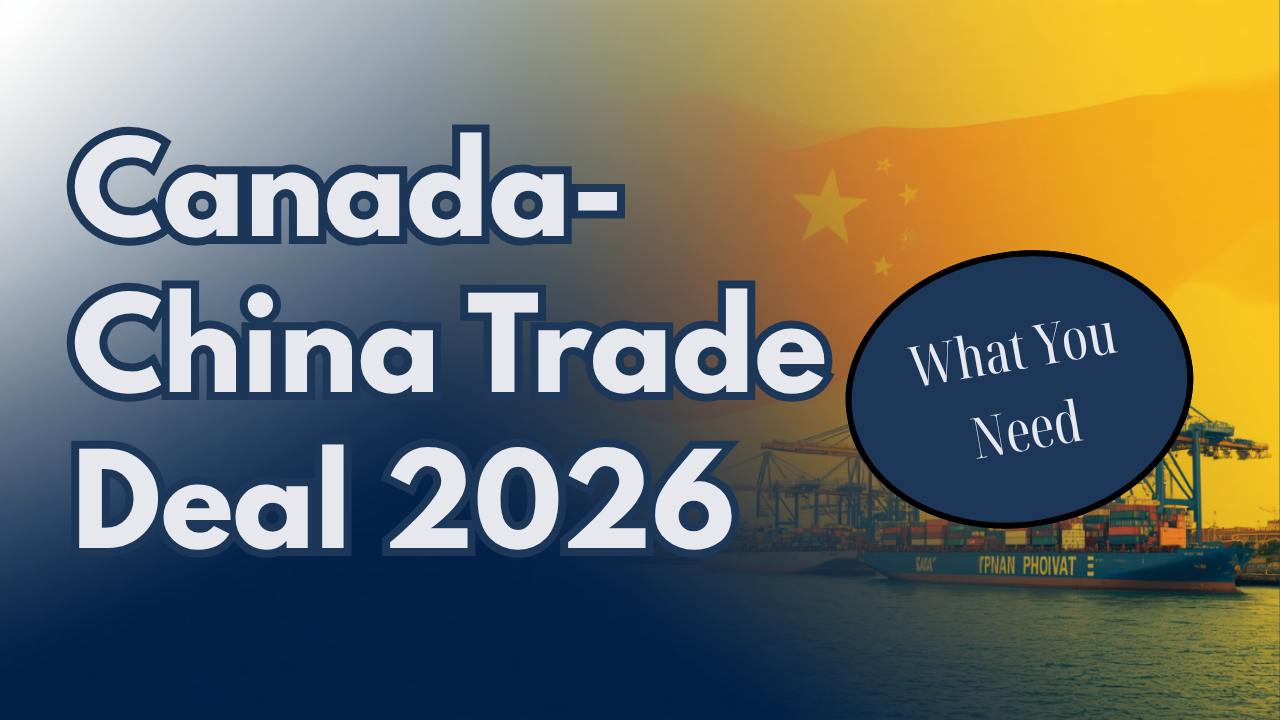
The term "Canada-China trade deal" has been trending in Canadian search results throughout 2026 — and for good reason. After years of trade tension between Canada and China, a significant diplomatic and economic reset began under Prime Minister Mark Carney's government, with Canada actively pursuing deeper trade engagement with China as part of a broader strategy to reduce economic dependence on the United States.
For Canadian importers who source goods from China, the implications are significant. The Canada-China trade deal — more accurately described as a series of trade framework agreements and tariff negotiation developments — has the potential to reshape the cost of importing from China, the compliance landscape, and the competitive dynamics of the Canadian import market.
This guide explains what's actually happening with Canada-China trade in 2026, what it means for your duties and landed costs, and what practical steps Canadian importers should be taking right now.
Canada-China trade relations deteriorated sharply between 2018 and 2023. The diplomatic fallout from the Meng Wanzhou/Huawei affair, combined with Canada's alignment with US tariff and technology policy, created a period of significant friction. China imposed informal trade barriers on Canadian agricultural exports — canola, barley, beef — while official relations remained frosty.
The Trudeau government's imposition of 100% tariffs on Chinese-made electric vehicles in August 2024, mirroring similar US measures, marked a low point. Canada-China trade volumes held steady in goods categories like consumer products and industrial components, but the strategic relationship was strained.
The 2025 Canadian federal election changed the trajectory. Prime Minister Carney, facing the twin pressures of US tariffs on Canadian goods and a domestic economy under stress, moved to reset the China relationship as a strategic counterbalance. High-level diplomatic engagement resumed, trade missions to Beijing were announced, and both governments signalled willingness to negotiate a more structured bilateral trade framework.
It's important to be precise about what "deal" means here, because the media coverage has been imprecise. Canada and China do not have a free trade agreement — no such agreement has been concluded. What exists in 2026 is a combination of:
What this is not is a comprehensive free trade agreement with scheduled duty reductions across product categories. Canadian importers should not expect the kind of systematic tariff phase-down that CUSMA or CPTPP provides. The Canada-China tariffs applicable to most imported goods remain at their MFN (Most Favoured Nation) levels for now.
For Canadian businesses importing goods from China, the practical impact of the 2026 Canada-China trade developments breaks down as follows:
Duties on most imported goods: No significant change (yet)
Canada's MFN tariff rates on Chinese goods are unchanged for most product categories. If you were paying 6% duty on your imported consumer electronics or 12% on apparel, those rates still apply. The framework agreements announced in 2026 do not include scheduled duty reductions on manufactured goods imported to Canada.
Agricultural exporters: Meaningful improvement
Canadian canola, barley, beef, and seafood exporters are the primary beneficiaries of the improved bilateral relationship. Informal Chinese restrictions on these categories are being eased, which is significant for those sectors — though not directly relevant to most importers.
Electric vehicles: Complex picture
Canada's 100% surtax on Chinese-made EVs remains in place pending a formal review. The diplomatic reset has softened rhetoric but has not resulted in tariff relief for Chinese EV imports.
Supply chain confidence: Improved
Perhaps the most tangible benefit for importers is reduced geopolitical uncertainty. The improved bilateral relationship reduces (though does not eliminate) the risk of sudden retaliatory trade measures affecting goods in transit or on order. If you've been hesitant to place large orders with Chinese factories because of trade war risk, the 2026 diplomatic environment is modestly more stable.
Currency and payment processing: Slightly easier
Bilateral financial services discussions have resulted in improved banking cooperation, which may modestly reduce friction in international payments to Chinese suppliers — though the practical impact varies by bank and transaction type.
Understanding your duty exposure is fundamental to running a profitable import business. Canada's tariff schedule for Chinese-origin goods is based on the MFN rate for each HS code — there is no preferential rate for Chinese goods equivalent to what CPTPP provides for Vietnamese or other CPTPP-member goods.
Common duty rates for goods imported from China to Canada include:
These rates are in addition to GST (5%) on the total duty-paid value of the goods. Understanding how to calculate your import duty correctly is critical — getting it wrong exposes you to CBSA assessments and penalties.
The Canada-China trade deal discussions have not altered these rates for manufactured goods, but the conversations are ongoing. Importers should monitor CBSA and Global Affairs Canada announcements for any changes that affect their specific product categories.
Separate from the bilateral trade deal discussions, Canadian importers sourcing from China must navigate the CARM (CBSA Assessment and Revenue Management) system, which has been mandatory for commercial importers since 2024. CARM changes how duties and taxes are assessed and paid, and non-compliant importers face delays and potential penalties.
If you haven't already registered in CARM and set up your importer account, this is an urgent compliance priority — completely independent of the Canada-China trade deal. Our CARM 2026 guide for Canadian importers walks through the registration process and what you need to have in place.
The Canada-China trade reset creates a window of opportunity for Canadian importers — but it also underscores the importance of not treating China as your only sourcing option. Here's how experienced importers are responding:
1. Lock in pricing with current suppliers while the environment is stable
The improved diplomatic relationship creates a window of relative stability. Use this period to negotiate longer-term supply agreements with your Chinese factories, locking in pricing and priority production allocation.
2. Don't assume the deal changes your landed cost
Until specific duty reductions are announced for your product category, do not adjust your financial models. The current frameworks are in negotiation — they are not concluded agreements with enforceable tariff schedules.
3. Continue developing alternative supply options
Diplomatic improvements don't eliminate supply chain risk. The China+1 strategy — maintaining a primary Chinese supplier while developing a backup in Vietnam or another ASEAN market — remains sound regardless of the bilateral political climate. Geopolitics can shift faster than supply chains can be rebuilt.
4. Review your HS code classifications
If you haven't had a professional review your HS codes recently, now is a good time. Misclassification is the most common cause of unexpected duty exposure for Canadian importers — and CBSA audit activity has increased under CARM. Understanding your HS codes correctly is both a compliance requirement and a cost-saving opportunity.
5. Watch the EV surtax review closely
If your business involves any EV-adjacent product categories — batteries, charging infrastructure, components — the outcome of Canada's 100% EV surtax review will be highly material. This review is expected to produce a decision in late 2026.
The Canada-China trade framework is a work in progress. Key milestones to watch in the second half of 2026 include:
Canadian importers should subscribe to Global Affairs Canada trade updates and work with a customs broker who actively monitors tariff schedule changes. The CBSA tariff schedule is updated regularly — and changes can take effect quickly.
Has Canada signed a free trade agreement with China in 2026?
No. Canada and China do not have a comprehensive free trade agreement. The trade developments in 2026 involve framework negotiations, improved diplomatic relations, and sector-specific discussions — but no concluded FTA with scheduled duty reductions on manufactured goods.
Will the Canada-China trade deal lower my import duties?
Not for most manufactured goods categories at this stage. MFN duty rates on Chinese-origin goods are unchanged. Monitor CBSA announcements for any changes to your specific HS codes.
How does the Canada-China trade deal compare to CPTPP?
CPTPP provides concrete, scheduled duty reductions for goods originating in member countries including Vietnam, Japan, and Malaysia. The Canada-China discussions are at a much earlier stage and provide no equivalent duty relief for most imported goods right now. CPTPP remains the more actionable preferential trade framework for Canadian importers.
Should I be worried about Canadian tariffs on Chinese goods increasing?
The improved diplomatic environment reduces (but doesn't eliminate) this risk. Canada has shown willingness to impose surtaxes when it aligns with trade policy objectives — as it did with EVs in 2024. The current political environment is less adversarial, but importers should maintain contingency plans.
What is CARM and do I need to worry about it?
Yes. CARM (CBSA Assessment and Revenue Management) is mandatory for all commercial importers to Canada and has been in effect since 2024. If you haven't registered and set up your importer account, this is an immediate priority. See our CARM guide for full details.
Navigating Canada-China trade policy, CARM compliance, duty optimisation, and supplier management is complex — and getting it wrong is expensive. Epic Sourcing Canada works exclusively with Canadian businesses importing from Asia, giving you a team that understands both the Canadian regulatory environment and the realities of Chinese supply chains.
Whether you want a landed cost review for your current product range, guidance on diversifying into Vietnam under CPTPP, or help managing your China supplier relationships through a period of trade uncertainty, we can help.
Contact the Epic Sourcing Canada team to discuss your sourcing strategy for the second half of 2026 and beyond.