How Canadian businesses can source and import drip irrigation systems and water management equipment from China, including duties, compliance, and supplier selection.
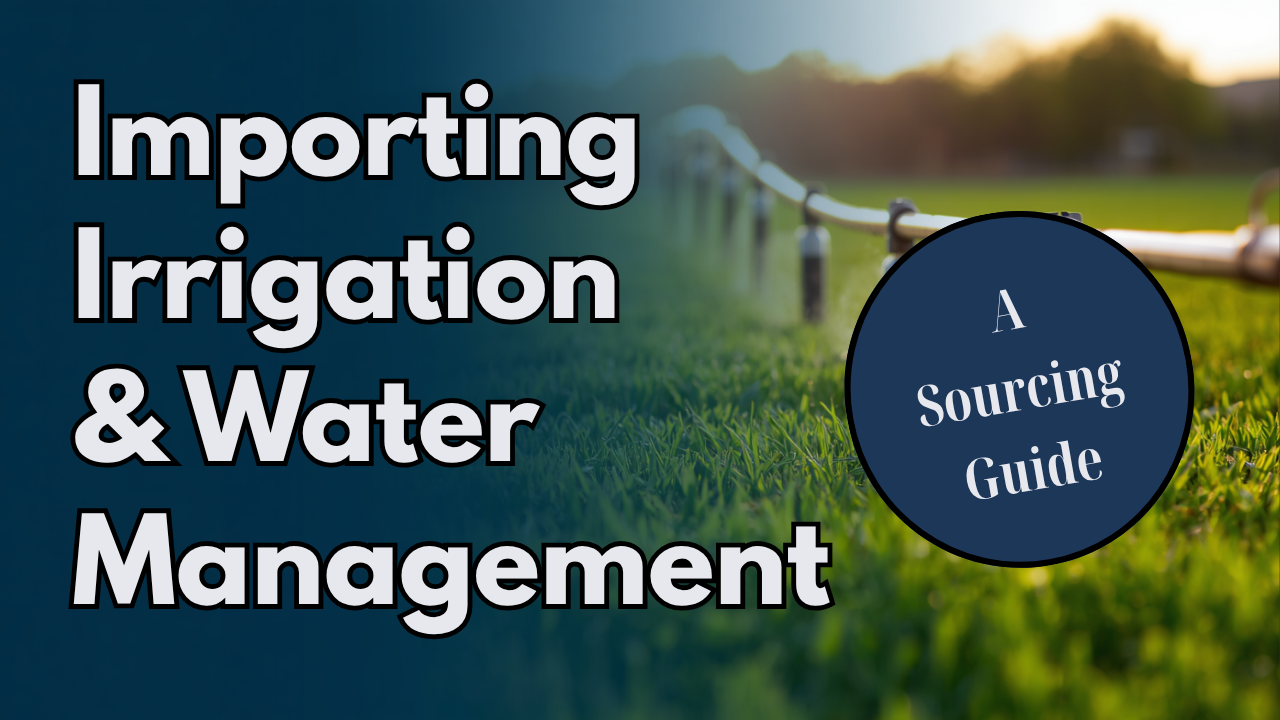
Canada's agriculture, landscaping, and horticulture industries rely on efficient water management — and the market for drip irrigation systems has never been more active. Whether you're supplying commercial growers in BC's Okanagan, landscaping contractors across the Prairies, or garden retailers nationwide, sourcing irrigation equipment and water management products directly from Chinese manufacturers offers significant cost advantages over buying locally or through middlemen.
This guide explains how Canadian businesses can import irrigation and water management equipment from China in 2026 — covering supplier selection, import duties, compliance requirements, and shipping logistics.
China is one of the world's largest manufacturers of irrigation equipment, producing everything from residential garden drip kits to large-scale commercial agricultural drip irrigation systems. The manufacturing base is concentrated in Hebei, Shandong, and Zhejiang provinces, with hundreds of factories specializing in drip tape, emitters, filters, fittings, valves, and complete system assemblies.
The price differential is compelling. A commercial-grade drip irrigation system that a Canadian distributor might price at CAD $800–$1,200 can be sourced factory-direct for USD $150–$300 — and even after freight, duties, and logistics costs, margins remain strong. For irrigation supplies that Canadian retailers stock at $50–$200 per unit, sourcing from China fundamentally restructures the economics of the business.
Water management and irrigation equipment covers a wide range of products. The most commonly imported categories include complete drip irrigation systems (kits with drip tape, emitters, connectors, filters, and timers), agricultural drip tape and emitter lines, sprinkler systems for residential and commercial lawn irrigation, soaker hoses, smart irrigation controllers (Wi-Fi and app-controlled), water filters and pressure regulators, submersible and centrifugal pumps, fertigation injectors and proportioners, and soil moisture probes and rain sensors. Each product category has its own HS code, duty rate, and compliance pathway — and they vary significantly.
Irrigation equipment doesn't fall under a single HS code. Here are the most common classifications and their MFN duty rates:
The 6.5% duty on plastic fittings and hose adds up quickly on high-volume irrigation supply orders. Correctly classifying your products and building an accurate landed cost model before placing your order is essential for accurate pricing to your customers. In all cases, 5% GST is assessed at the Canadian border on the full value of the shipment including freight.
Unlike electrical products, most passive irrigation equipment — drip tape, fittings, valves, and hose — does not require mandatory Canadian safety certification for sale. However, there are important considerations by product type.
For plastics in potable water contact applications, NSF/ANSI 61 certification (Drinking Water System Components) is required. For agricultural irrigation where water doesn't enter the food supply directly, this is less critical but worth confirming with your target customers. Smart irrigation controllers and Wi-Fi timers must be ISED certified for radio frequency compliance — this is mandatory for any wireless device sold in Canada, similar to FCC certification in the US. Submersible pumps connected to the electrical system require CSA or cUL certification. And as always, Canada's Consumer Packaging and Labelling Act requires bilingual English/French packaging for retail sale.
Build all compliance requirements into your product specification before production begins. Retrofitting labels or recertifying products after arrival is expensive and delays your market entry. Your supplier specification sheet should include all labelling, marking, and certification requirements from day one.
The Chinese irrigation equipment sector ranges from large integrated factories supplying global agricultural distributors to small workshops assembling drip kits from sourced components. Quality varies considerably — substandard plastic fittings that fail mid-season create significant liability for Canadian distributors and retailers.
A practical approach to supplier selection: start on Alibaba or Made-in-China and filter for Trade Assurance suppliers; request material certifications (for potable water applications, ask for NSF 61 test reports); ask for OEM references showing supply to recognized international brands; order samples and physically test fittings for pressure rating, fit consistency, and UV resistance before approving production; and for orders above CAD $25,000, commission a third-party factory audit.
Understanding the difference between dealing with a factory versus a trading company matters here. Trading companies offer wider product ranges but add a markup layer and can obscure production quality. Factory versus trading company — which is right depends on your volume, product range, and quality control requirements.
Irrigation equipment is generally dense, heavy, and stackable — well-suited for efficient ocean freight. Ocean freight from Ningbo or Shanghai to Vancouver runs USD $1,000–$2,000 per 20' container at 2026 rates. Transit time is 18–25 days to Vancouver, or 22–30 days to Toronto via Vancouver and rail. For urgent or high-value small orders (smart controllers, specialty equipment), air freight is feasible at USD $4–$8/kg. For orders that don't fill a container, LCL (Less than Container Load) consolidation from most Chinese ports keeps your options open on smaller initial orders before you move to full FCL volume.
Standard payment terms from Chinese irrigation factories are 30% deposit on order confirmation, 70% before shipment. For new supplier relationships, this structure protects the factory — but it also means your capital is at risk if quality issues emerge at shipment time.
Strategies to protect yourself: use Alibaba Trade Assurance for platform orders (it provides milestone payment protection and dispute resolution); negotiate payment release against a pre-shipment inspection report rather than unconditionally before inspection; for larger orders, Letter of Credit terms are available from established factories and provide stronger buyer protection; and as relationships mature, many Chinese factories will extend 30/70 or net-30 terms to consistent buyers.
Irrigation is a seasonal category in most of Canada — demand peaks from April through August, with purchasing decisions made months earlier. Chinese New Year (typically late January to mid-February) causes factory shutdowns of 2–4 weeks, meaning orders placed in January may not ship until late February or March. Pre-season orders placed October through December give maximum lead time flexibility. For in-season reorders of fast-moving SKUs, air freight becomes a viable option when stockouts are the alternative.
Planning your inventory with Chinese factory lead times in mind is essential to avoiding spring stockouts in a category where retailer and distributor relationships depend on reliable availability.
Most drip irrigation systems and sprinkler equipment (HS 8424.81/82) enter Canada at a 0% MFN duty rate. Plastic fittings and tubing (HS 3917) typically attract 6.5% duty. GST of 5% applies to all imports regardless of product duty rate.
Passive irrigation equipment (drip tape, fittings, hose) doesn't require mandatory certification, but potable water contact applications should meet NSF/ANSI 61. Electronic products (smart controllers, Wi-Fi timers) must be ISED certified. Pumps connected to the electrical grid need CSA certification.
Start with Alibaba or Made-in-China, filter for Trade Assurance and verified suppliers, request samples and factory documentation, and commission a pre-shipment inspection before committing to production. For larger orders, a third-party factory audit provides additional quality assurance.
Drip tape is often sold by the roll or pallet (500–1,000 metres minimum). Complete drip irrigation kits may have MOQs of 50–200 units. Fittings and connectors often have low MOQs. Custom packaging or private-label branding typically requires higher minimums of 200–500 units.
Yes — private-label and OEM opportunities are widely available from Chinese irrigation manufacturers. You can brand drip systems, smart controllers, and garden irrigation kits with your own mark and packaging. MOQs for private-label runs typically start at 200–500 units depending on the product.
Sourcing irrigation and water management equipment from China means navigating a wide supplier landscape, variable product quality, and compliance requirements that differ by product type and end-use application. Getting the wrong factory or missing a certification requirement can mean delayed shipments or product that can't be sold.
Epic Sourcing Canada helps Canadian businesses source irrigation equipment and water management products directly from vetted Chinese manufacturers. From supplier identification and sample coordination to pre-shipment inspection and Canadian customs compliance, we manage the sourcing process so you can focus on growing your business.
Contact our team to discuss your irrigation sourcing project — no obligation, just a practical conversation about what's possible for your business in 2026.