Most Canadian importers have never set foot in a Chinese factory — but understanding how they operate is one of the highest-ROI moves you can make before placing your first order.
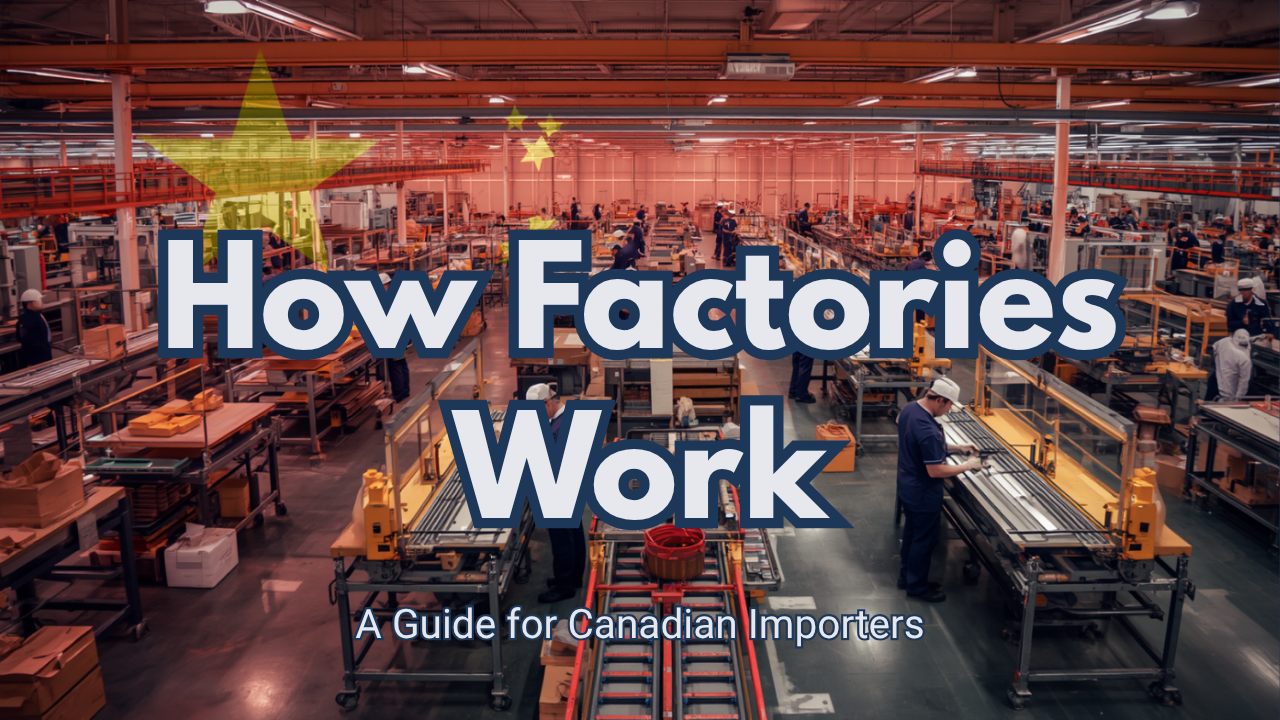
Most Canadian importers spend weeks researching products, comparing prices on Alibaba, and agonizing over samples — but they've never thought about what actually happens on the factory floor. That's a gap that costs money.
When you understand how Chinese factories work, you stop making rookie mistakes: overpaying because you don't understand factory cost structures, getting locked into bad lead times because you misread production cycles, or failing quality inspections because you didn't know your factory subcontracts finishing to a third party.
This guide breaks down the Chinese manufacturing ecosystem in plain language — written specifically for Canadian business owners who are importing or planning to import but haven't had the chance to visit the factory floor in person.
One of the biggest misconceptions Canadian importers hold is that "made in China" means one monolithic factory system. In reality, China's manufacturing landscape is a complex ecosystem of specialized factories, trading companies, finishing workshops, and raw material suppliers — often clustered by region and product type.
The largest export-focused factories are typically located in Guangdong, Zhejiang, and Jiangsu provinces. These tend to have English-speaking sales teams and experience dealing with North American and European buyers. Prices are generally higher here, but so are systems and reliability.
Beyond the big export hubs are specialized manufacturing clusters: Yiwu for small consumer goods and gifts, Dongguan for electronics and plastics, Foshan for furniture and home goods, Wenzhou for shoes and leather accessories. If your product has a natural home in one of these clusters, you'll find deeper specialization and more competitive pricing than in a generalist factory.
Even within a single factory, it's common for portions of production to be subcontracted — packaging printed elsewhere, finishing done by a smaller workshop nearby, components sourced from a specialist supplier two cities over. This is normal, but it affects your quality control approach. When you work with a sourcing agent for Canadian importers, part of their value is knowing which clusters specialize in your product and which factories are genuinely capable for your order size.
Not every supplier you contact on Alibaba is actually a factory. Understanding the different supplier types helps you choose the right partner and negotiate accordingly.
OEM (Original Equipment Manufacturer): Makes products to your specifications. You provide the design, dimensions, materials, and branding — they manufacture. Best for private label and custom products. Requires a well-developed product spec before you get accurate pricing.
ODM (Original Design Manufacturer): Has its own existing designs that they sell to multiple buyers. You can typically brand their product with your logo and sometimes make minor modifications. Faster to market and lower development cost, but less differentiation from competitors who may source the same base product.
Trading Companies: Not manufacturers at all — they aggregate products from multiple factories and act as intermediaries. Useful for small orders or mixed-product buying. Prices are typically 10–30% higher than going direct, and your visibility into actual production is limited.
Direct Factories: Manufacturers with no trading intermediary. Best pricing and maximum control, but they often require higher MOQs and may have limited English capability or export logistics experience.
For Canadian importers building a branded product line, understanding the factory vs trading company tradeoff is one of the most important sourcing decisions you'll make early on.
Once you've placed a purchase order with a Chinese factory, here's what typically happens. Timelines vary by product complexity, factory capacity, and whether this is a first or repeat order.
1. PO confirmation and deposit payment: Most factories require a 30% deposit before production begins. This triggers procurement of raw materials and reserves your production slot.
2. Raw material procurement: The factory sources materials — fabric, resin, metal components, PCBs, carton board. This alone can take 1–3 weeks depending on what's in stock versus what needs ordering.
3. Pre-production sample (PP sample): The factory produces a sample for your approval before mass production. This is your last chance to catch specification issues before thousands of units are built. Always review your PP sample carefully against your original spec sheet.
4. Mass production: Once you approve the PP sample, production begins. Factories run production lines by product family, and your order may sit in a queue depending on current load. Peak seasons before Chinese New Year can cause delays.
5. Quality inspection: Quality checks happen during production (in-line) and before shipment (final). If you've hired a third-party quality inspection company, their inspector visits the factory at this stage and checks your goods against your approved sample and specifications.
6. Packaging, labelling, and loading: Finished goods are packed into cartons and prepared for shipment. This is where Canadian bilingual labelling requirements need to be in place — if your label isn't ready, your goods aren't ready.
7. Balance payment and document release: The remaining 70% is typically due before the factory releases shipping documents. Your freight forwarder and customs broker will need these documents to clear your goods through CBSA.
When you email your factory contact, you're rarely speaking directly to production management. Understanding the layers helps you communicate more effectively and get accurate information.
Salesperson (外贸业务员): The person you're most likely dealing with via Alibaba, email, or WeChat. They're intermediaries between you and the production team. Skilled salespeople are excellent communicators; less experienced ones sometimes create specification gaps by misunderstanding or mistranslating details.
Production Manager: Oversees the manufacturing floor. Rarely communicates directly with international buyers, but their handling of your requirements determines whether specs actually make it to the production line.
QC Team: Responsible for in-house quality checks. Their standards and your standards don't always align — which is why independent third-party inspection exists and is worth every cent.
Factory Owner or Senior Management: Often involved in larger or high-value orders. Accessible when you're building a strategic, long-term relationship.
A critical rule experienced importers learn: always confirm all specifications in writing, with photos or technical diagrams where possible. Verbal agreements and informal WeChat messages don't hold up in a production dispute.
Many factories exporting to North America and Europe have ISO 9001 certification and sophisticated quality management systems. But certification alone doesn't guarantee consistent product quality — execution does.
Incoming Quality Control (IQC): Checks raw materials and components when they arrive. A factory with poor incoming QC can produce bad products even with excellent equipment. This is where low-grade material substitution often occurs.
In-process Quality Control (IPQC): Spot checks during production. Catching a defect at unit 100 prevents losses at unit 4,900. In-process QC quality varies widely between factories.
Final Quality Control (FQC): Inspection of finished goods before packing. Internal FQC passes are not a substitute for third-party inspection if product quality is critical to your business.
For Canadian importers, relying solely on the factory's internal QC is a meaningful risk. A professional pre-shipment inspection — typically $250–$400 CAD — checks your goods against your approved sample using AQL sampling standards. It's one of the highest-ROI steps you can take before releasing your balance payment.
Whether you're vetting factories on Alibaba or through a sourcing partner, these warning signs deserve serious scrutiny before you commit:
If you're using Alibaba to source suppliers for the first time, always cross-reference with verified trade data, request a video call before sending any payment, and never skip the physical sample stage.
Most Chinese factories communicate via email, Alibaba messaging, or WeChat. A few principles that reduce errors and misunderstandings:
Use numbered lists, not paragraphs. "Please see the following 5 requirements" is clearer than a paragraph of prose that needs to be translated and interpreted.
Attach photos and diagrams. An image of what you want — or explicitly don't want — is worth a thousand words when working across a language barrier.
Follow up every call with an email summary. "Confirming what we agreed: carton size 60x40x40cm, label placement on front panel, Pantone 186C red." This becomes your paper trail.
Be direct and specific about problems. Chinese business culture values relationship harmony, which can sometimes result in optimistic timelines rather than clear problem statements. When something is wrong, name it specifically and ask for a clear resolution and timeline.
Build holiday buffer into your production timeline. Chinese New Year (late January to mid-February) shuts manufacturing down for 2–4 weeks. Plan your order timing around these — particularly if you're working to Canadian retail deadlines.
No — many successful Canadian importers have never visited China. A strong sourcing partner with on-the-ground presence can perform factory assessments, quality inspections, and ongoing relationship management on your behalf. That said, visiting your key supplier at some point does build trust and gives you an operational understanding of what's actually possible at your factory.
Ask for their business licence — a genuine manufacturer will have a manufacturing business licence rather than just a trading company registration. You can also ask for a live video tour of the production floor. Platforms like SGS and Bureau Veritas, and Alibaba's Supplier Assessment program, can verify factory status.
For most consumer goods, a realistic lead time from deposit payment to finished goods ready to ship is 45–75 days, depending on product complexity and factory capacity. Add 25–35 days for sea freight to Canadian ports. Plan for 70–110 days total from order to warehouse, and always build in buffer for the unexpected.
Use both, but keep important decisions and approvals in email. WeChat is excellent for quick questions and relationship building. For formal purchase orders, specification approvals, and QC sign-offs, always use email — it creates the audit trail you'll need if a dispute arises.
Yes — mould ownership disputes are one of the most common problems Canadian importers face when switching suppliers. Always clarify mould ownership in your purchase order or supplier agreement before paying for tooling. Your agreement should specify the mould is your property and must be returned or destroyed at your instruction.
Understanding how Chinese factories work is valuable — but navigating them effectively from Canada requires on-the-ground presence, established relationships, and years of operational experience. At Epic Sourcing Canada, we maintain verified factory relationships across China's key manufacturing regions and manage the full sourcing process on behalf of Canadian importers: supplier vetting, factory audits, production oversight, quality inspections, and logistics coordination.
Whether you're sourcing from China for the first time or looking to professionalize a supply chain you've built yourself, contact our team to discuss how Epic Sourcing Canada can help you import smarter.