A complete step-by-step guide for Canadian small and medium businesses on how to source products from China in 2026 — covering supplier vetting, duties, shipping, compliance, and how to avoid the most common mistakes.
Sourcing products from China remains one of the most powerful ways for Canadian businesses to reduce costs, access a wider product range, and build competitive margins. But for first-time importers, or businesses scaling up their sourcing operations, the process can feel overwhelming.
This guide walks you through every stage of sourcing from China to Canada in 2026 — from finding the right supplier to getting your goods through CBSA customs and onto your warehouse shelf.
China is Canada's second-largest trading partner and by far the world's largest manufacturing hub. For Canadian SMEs, sourcing from China offers several core advantages.
The most significant is cost. Chinese manufacturers benefit from large-scale production, highly automated processes, and deeply developed supply chains that allow them to produce goods at prices Canadian or US manufacturers simply cannot match. For most consumer goods categories — electronics, textiles, packaging, hardware, home goods, and sporting equipment — the cost difference between China-sourced and domestically produced goods can be 40 to 70 percent.
Beyond cost, China offers unmatched product breadth. Whether you need a bespoke private-label product or an off-the-shelf item, there is almost certainly a Chinese manufacturer already producing it at scale. This makes China the go-to starting point for product businesses at any stage.
In 2026, the sourcing landscape has also shifted. A preliminary Canada-China trade agreement — informally known as the EVs-for-Canola deal — has eased some of the diplomatic tension that slowed trade in previous years. While the full impact of this agreement is still unfolding, Canadian importers are cautiously optimistic about improved supply chain predictability.
The single biggest mistake Canadian importers make is approaching suppliers before they have a clear product specification. Vague inquiries attract vague responses — and you end up comparing quotes that are not comparing the same thing.
Before you contact a single factory, document the following.
Your product specification should include exact dimensions, materials, weight, colour options, and packaging requirements. If you have a reference product, photograph it from every angle and include measurements. If you are developing something new, sketch it out and note every functional requirement.
Your compliance requirements must be defined upfront. Does your product need CSA certification? ETL listing? Health Canada approval? Does it require bilingual English-French labelling under Canadian law? If you sell into Quebec or market your product nationally, French labelling is not optional — it is a legal requirement. Knowing your compliance requirements before you source will filter out suppliers who cannot meet them.
Your target price and minimum order quantity (MOQ) should be realistic. Research the going rate for your product category on Alibaba before setting a target. If your target is far below market, you will either attract unqualified suppliers or end up with substandard products.
There are three primary methods Canadian importers use to find Chinese suppliers: online B2B marketplaces, trade shows, and sourcing agents. Each has its place depending on your experience level and product complexity.
Online B2B Marketplaces
Alibaba is the largest and most accessible platform for Canadian buyers. It lists millions of verified manufacturers and trading companies across virtually every product category. Alibaba's Trade Assurance program adds a layer of payment protection that makes it safer for first-time importers.
For more price-competitive sourcing, experienced buyers also use 1688.com — Alibaba's domestic Chinese platform, which lists factories at wholesale prices without the export markup. However, 1688 is entirely in Chinese and requires either a Chinese intermediary or strong language skills to use effectively.
Global Sources and Made-in-China are two other credible B2B platforms with strong supplier bases in electronics, industrial goods, and consumer products.
Trade Shows
The Canton Fair, held twice yearly in Guangzhou, is the world's largest trade fair and the single best place to meet Chinese manufacturers in person, handle product samples, and build supplier relationships. For Canadian importers who are serious about sourcing at scale, attending Canton Fair at least once is worth the investment.
Sourcing Agents
A China sourcing agent is a company or individual based in China (or with strong China operations) who acts on your behalf to find suppliers, negotiate prices, conduct quality inspections, and manage logistics. For Canadian SMEs that lack the time, language skills, or on-the-ground knowledge to source independently, a professional sourcing agent can significantly reduce risk and cost.
The right sourcing agent will know which factories in a given region are reliable, which are known for cutting corners, and how to structure a purchase order that protects you. Epic Sourcing Canada has operations across China and Vietnam, working directly with verified manufacturers in every major product category. Contact us to discuss your sourcing needs.
Finding a supplier on Alibaba is easy. Finding a reliable one takes discipline.
Start by filtering for Verified Suppliers or Gold Suppliers with at least three to four years on the platform. Read the reviews and look for patterns — repeated complaints about shipping delays or quality discrepancies are red flags regardless of how polished the storefront looks.
Request a factory audit report or have a third-party inspection company (such as QIMA or Bureau Veritas) conduct an on-site factory audit before you place your first order. This is especially important for higher-value orders or products with strict compliance requirements.
Always request samples before committing to a production order. Evaluate the sample against your specification in detail — check dimensions, materials, finish quality, packaging, and any labelling requirements. Never skip the sampling stage to save time. The cost of a bad production run is always higher than the cost of a sample.
Verify that the factory's business licence is legitimate and that they have experience exporting to Canada specifically. Canadian compliance requirements (bilingual labelling, CSA, Health Canada) are different from US or European requirements, and not all factories are familiar with them.
Chinese suppliers expect negotiation. Accepting the first quoted price is leaving money on the table.
The most effective negotiation lever is volume. If you can credibly commit to repeat orders, suppliers will sharpen their pricing significantly. Even if your first order is small, communicating that you plan to scale gives you negotiating room.
Payment terms follow a standard structure on Alibaba. Most suppliers require a 30 percent deposit upfront, with the remaining 70 percent due before shipment. For new relationships, always pay through Alibaba Trade Assurance — your payment is protected if the supplier fails to meet agreed specifications or delivery timelines.
For repeat orders with established suppliers, you may be able to negotiate more favourable terms such as net 30 or a 20/80 split. Always get final payment terms in writing in a proforma invoice or purchase order before transferring any funds.
When your supplier quotes you a price, it will include an Incoterm that defines exactly where their responsibility ends and yours begins. The most important Incoterms for Canadian importers to understand are FOB, EXW, CIF, and DDP.
FOB (Free on Board) is the recommended starting point for most Canadian SMEs. Under FOB terms, your supplier handles everything until your goods are loaded onto a vessel at the named Chinese port (e.g., FOB Shanghai, FOB Ningbo). From that point, you arrange and pay for ocean freight, marine insurance, Canadian import clearance, duties, and inland delivery. FOB gives you control over your freight costs while keeping the China-side logistics with the supplier.
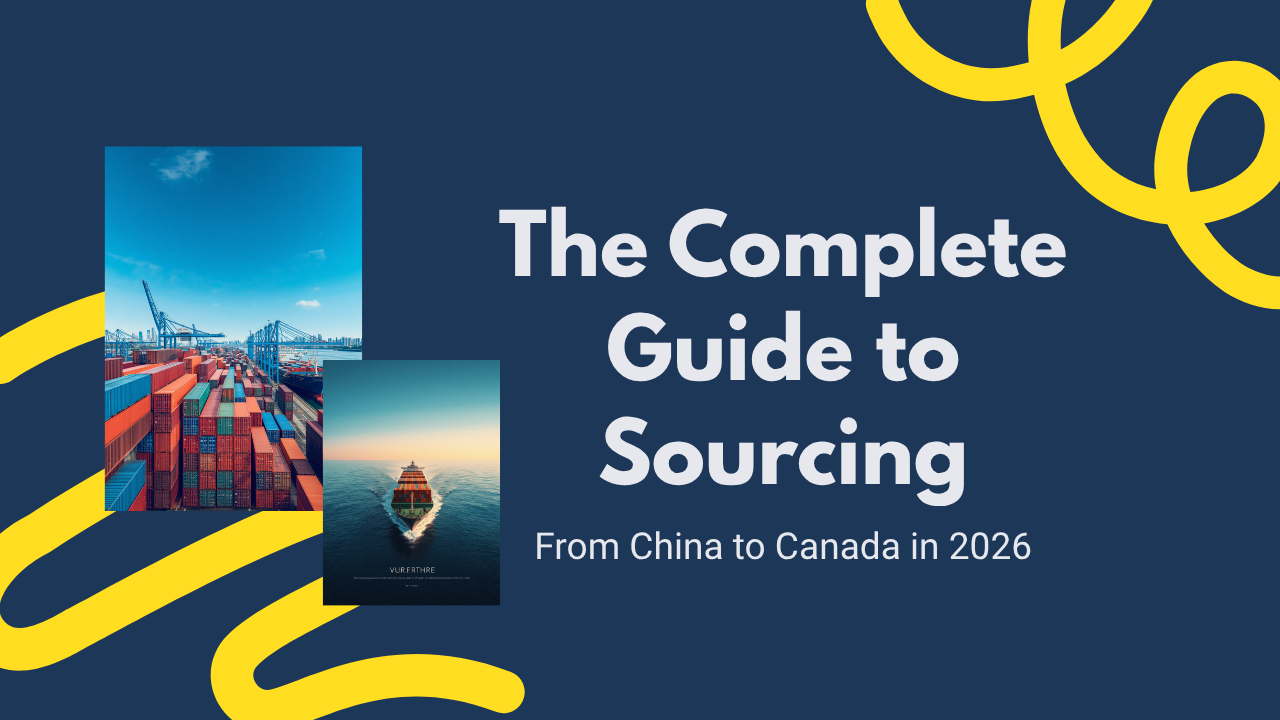
For most shipments from China to Canada, ocean freight is the most cost-effective option. A standard 20-foot container from Shanghai to Vancouver runs approximately $3,000 to $5,000 depending on season and market conditions, with a transit time of 15 to 20 days. Shipments to Toronto or Montreal add 12 to 18 additional days and $1,000 to $1,500 in freight cost.
For smaller shipments under approximately two to three cubic metres, LCL (Less than Container Load) consolidation allows you to share container space with other importers, paying only for the space your cargo occupies. Air freight is an option for time-sensitive, high-value, or low-weight shipments but costs approximately five to eight times the equivalent ocean freight rate.
Every commercial shipment arriving in Canada must be declared to the Canada Border Services Agency (CBSA). This process is typically handled by a licensed customs broker on your behalf.
You will need to provide your customs broker with a commercial invoice from your supplier, a packing list, a bill of lading or airway bill, and any applicable certificates of origin or compliance documentation. Your customs broker will classify your goods under the appropriate HS tariff code, calculate applicable duties and taxes, and file your entry with CBSA.
Import duties on Chinese goods vary widely by product category and are applied on top of the standard 5 percent federal GST. In 2026, Canadian importers should also be aware of the existing 25 percent surtax on certain Chinese steel and aluminum products, and the ongoing implications of the Canada-China trade negotiations on specific product categories.
If you are importing regularly, you should also be registered with the CARM (CBSA Assessment and Revenue Management) client portal. CARM modernises how importers interact with CBSA and is now the standard method for managing your import accounts, duty payments, and trade compliance history.
Quality control is where many Canadian importers — particularly first-timers — lose money. Ordering samples is important, but production quality does not always match sample quality, particularly with new suppliers or complex products.
For orders above approximately $5,000, investing in a pre-shipment inspection is strongly recommended. A third-party inspector visits the factory before goods are loaded, checks a statistically significant sample of your production run against your specifications, and provides a detailed inspection report. The cost is typically $250 to $350 USD per inspection day — a small price relative to the cost of receiving a full container of defective goods.
If you are using a sourcing agent, quality control is typically included in their service scope. A good agent will maintain supplier relationships and can apply pressure to resolve quality issues in a way that individual buyers often cannot.
After working with hundreds of Canadian importers, Epic Sourcing Canada has seen the same mistakes repeated at every stage of the sourcing process. The most costly ones to avoid are these.
Skipping the spec sheet is the most common mistake. Without a detailed specification, you have no legal basis for rejecting a production run that does not meet your expectations.
Choosing the cheapest supplier almost always ends in disappointment. The lowest quoted price is often a signal that the factory is planning to cut corners somewhere — on materials, quality control, or compliance documentation.
Ignoring Canadian compliance requirements is a mistake that can have serious consequences. Bilingual labelling requirements, product safety standards, and CBSA documentation requirements are not optional. Getting this wrong can mean customs holds, product recalls, or fines.
Not having a written purchase order is a risk that many importers underestimate. Verbal agreements with Chinese suppliers are unenforceable. Every order should be backed by a signed purchase order or proforma invoice that specifies product specifications, quantity, price, payment terms, delivery date, and inspection rights.
Sourcing from China successfully requires knowledge, relationships, and on-the-ground presence in ways that most Canadian businesses do not have in-house. Epic Sourcing Canada gives you access to a professional sourcing team with direct supplier relationships across China and Vietnam, covering everything from product development and supplier vetting through to quality control, logistics coordination, and customs preparation.
Whether you are placing your first order or scaling an existing product line, our team handles the complexity so you can focus on growing your Canadian business. Contact us today for a free sourcing consultation.