A practical guide for Canadian SME owners on importing outdoor and all-season recreation equipment — from supplier vetting to compliance, duties, and freight.
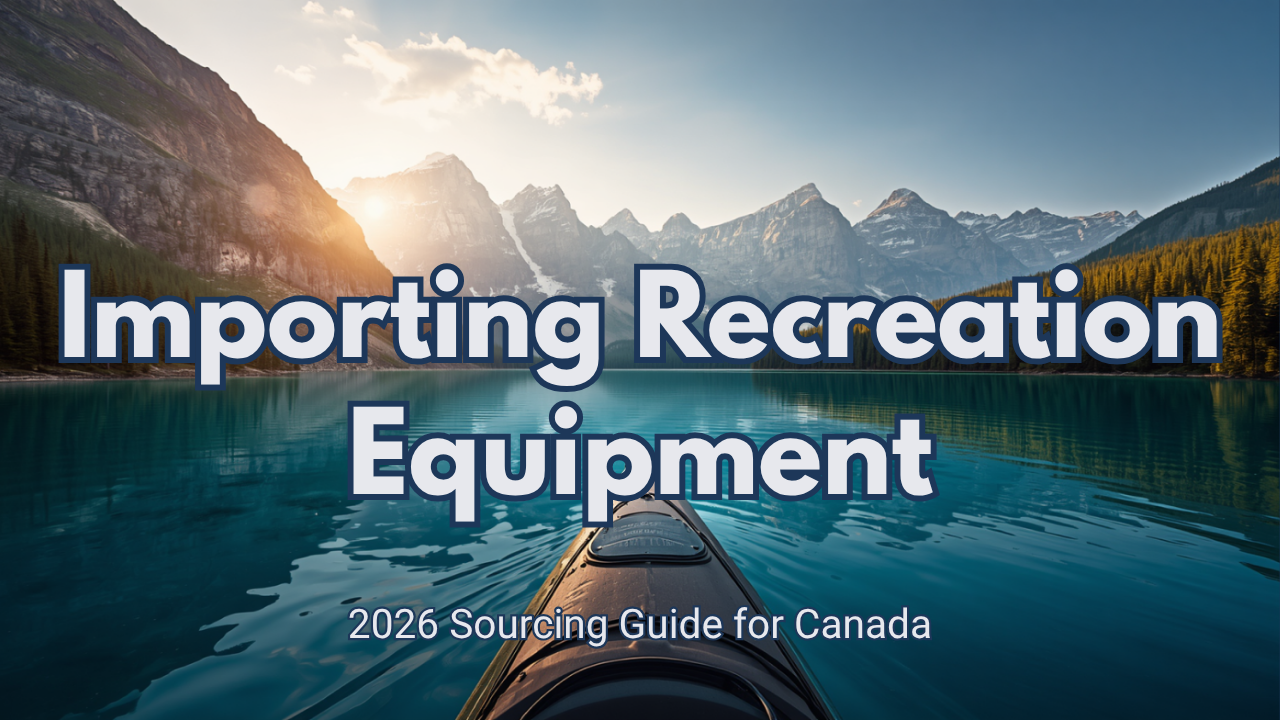
Canada's outdoor recreation market is booming. Whether you run a sporting goods store, manage a campground supply company, or sell seasonal gear online, sourcing outdoor equipment Canada businesses actually want — at competitive prices — means looking beyond domestic wholesalers. For many Canadian SME owners, importing directly from manufacturers in China, Taiwan, or Southeast Asia is the move that finally makes the margins work.
This guide walks you through everything you need to know about importing outdoor and all-season recreation equipment to Canada in 2026: product categories, compliance requirements, duties, supplier sourcing, and the practical steps to get your first shipment through CBSA without a headache.
The category is broad, which is part of what makes it interesting to import. It includes:
Each sub-category has its own compliance requirements and HS code, so you need to know exactly what you're importing before you start quoting suppliers.
Canadian wholesale distributors exist for most of these categories — but they're taking a margin on top of the landed cost. When you import directly, you're buying closer to the factory gate. For a product that retails at $80 in Canada, the factory price in China might be $8–$15 depending on the category and MOQ. Once you factor in freight, duties, and clearance, your landed cost might be $22–$30 — still leaving you a healthy margin versus paying $45+ to a local distributor.
The math changes when your volumes are too small to justify the logistics. Most ocean shipments become cost-effective once you're moving at least a pallet or two. For smaller operators, groupage (LCL) shipping or air freight works — but you'll want to do the landed cost calculation carefully before committing.
If you're unsure how to build a landed cost model, check out our guide to calculating landed costs for Canadian importers.
This is where many first-time importers get caught off guard. Canada has several overlapping regulatory frameworks that can apply depending on what you're importing.
Most consumer-facing outdoor products fall under the CCPSA. As the importer, you're the responsible party if a product causes harm. You need to ensure your supplier can provide test reports, and you should ideally be conducting pre-shipment inspections or third-party testing before the first shipment. The CBSA can detain shipments that lack compliance documentation.
Canada requires bilingual (English and French) labelling on consumer products sold nationally. Your supplier will not automatically do this — it's something you need to specify in your product brief and verify on samples. Many importers get factory labels in English and apply bilingual stickers, but for branded products, built-in bilingual labels look more professional and avoid regulatory grey areas.
Certain products have specific standards you must meet before importing:
For a deeper dive on product certification requirements, see our guide to CSA certification for Canadian importers.
Canada's import duties on outdoor recreation equipment vary significantly by product. Here's a general guide — always verify with CBSA or a customs broker before importing:
Even with 0% MFN duty, you still pay GST (5%) on the Canadian dollar value of goods plus freight. Some provinces apply PST on certain categories. Your customs broker will handle this calculation, but factor it into your landed cost model from day one.
Don't forget to factor in CARM (CBSA Assessment and Revenue Management) if you're a first-time importer registering with CBSA in 2026. You'll need to post security to get a release-prior-to-payment (RPP) privilege. Our CARM 2026 guide for Canadian importers explains the registration process step by step.
Most outdoor recreation equipment manufacturing is concentrated in China, with some categories shifting to Vietnam — especially apparel-adjacent gear like backpacks. Here's how to approach supplier sourcing.
Alibaba and Made-in-China.com are good starting points for supplier discovery. Filter for verified or gold supplier status and look for factories with export experience to Canada or the USA. The biannual Canton Fair in Guangzhou (held in April and October) is one of the best places to meet outdoor and sporting goods manufacturers face-to-face if you're planning a China trip. Alternatively, a sourcing agent can handle discovery, vetting, and quality control on your behalf — especially valuable for first-time importers or safety-sensitive products.
Never wire money to a supplier you haven't verified. At minimum, you should request and verify their business license, ask for existing compliance certificates (ASTM, CE, CSA equivalents), request references from existing North American buyers, order samples before committing to a production run, and conduct a factory audit for large or ongoing orders.
For a full walkthrough, see our guide on how to verify a Chinese supplier from Canada.
Outdoor recreation equipment tends to be bulky and low-density, which makes ocean freight the most practical option for most orders.
If you're not filling a full container, LCL (less-than-container-load) consolidation is the way to go. You pay per cubic metre (CBM) or tonne, whichever is greater. A pallet of camping equipment might be 2–3 CBM, costing roughly CAD $400–$600 in ocean freight from China, plus origin and destination handling charges. Once your volume justifies a full container, the per-unit cost drops significantly. A 40ft HC container from Guangzhou to Vancouver typically runs USD $2,500–$4,500 depending on season and carrier market.
For initial samples, pre-production proofs, and urgent re-stocks, air freight makes sense. Expect to pay roughly USD $6–$10/kg door-to-door from China to major Canadian cities. Fast but expensive at scale — use it strategically.
Outdoor and all-season recreation equipment is one of the most timing-sensitive import categories. Summer gear (kayaks, camping, cycling) needs to be ordered by January–February for April–May arrivals — production lead times run 30–60 days for standard products, longer for custom items. Winter gear (ski accessories, snowshoes, ice fishing) should be ordered by July–August for October–November arrivals.
Two critical timing traps: Chinese New Year (factories close 2–4 weeks in late January/early February — any order without a clear pre-CNY deadline will slip by at least a month) and peak shipping season in August–October (rates rise, space gets tight — book early and build buffer time into your inventory plan).
Many Canadian outdoor equipment importers start by sourcing direct — finding suppliers on Alibaba and managing communications independently. This works fine once you have experience and established relationships. But for first-time importers, or for safety-sensitive products where a compliance gap can be costly, a sourcing agent provides real value: supplier discovery and vetting, price negotiation, factory audits, production timeline management, and multi-supplier consolidation into a single shipment.
At Epic Sourcing Canada, we work with Canadian businesses across dozens of product categories including outdoor and recreation equipment. If your current supply chain isn't performing — or you're importing for the first time — we'd love to help you get it right from the start.
Technically you can self-clear shipments as the importer of record, but for most businesses, using a licensed customs broker saves time and reduces the risk of HS classification errors. For ocean freight shipments especially, a broker is worth the fee.
MOQs vary widely. Standard products (backpacks, tents, camping accessories) often have MOQs of 50–200 units. Custom-branded or private label products typically require 200–1,000+ units depending on product complexity and manufacturer.
Work with suppliers who have experience exporting to North America and can provide third-party test reports from accredited labs. For safety-critical products (helmets, PFDs), work with a sourcing agent or compliance consultant who can verify certifications before production completes.
Yes — Vietnam is growing for softgoods (backpacks, apparel, sleeping bags), Taiwan has strength in cycling components, and India manufactures some outdoor categories. However, China still dominates for variety, pricing, and capacity across most outdoor product categories.
The most common: not ordering samples before a production run, underestimating lead times, ignoring bilingual labelling requirements, failing to get compliance test reports, and not having a backup supplier plan. A good sourcing partner helps you avoid all of these before they cost you money.
Whether you're importing outdoor equipment in Canada for the first time or looking to level up an existing supply chain, Epic Sourcing Canada provides end-to-end sourcing support — from supplier discovery and factory vetting to quality control, consolidation, and freight coordination. We understand the compliance requirements, seasonal timing, and margin math that make outdoor equipment importing either a competitive advantage or a costly headache.
Ready to get started? Get in touch with our team and we'll help you map out your first (or next) outdoor equipment import.