A plain-language breakdown of Incoterms for Canadian importers — EXW, FOB, and DDP explained, with a real landed cost comparison and common mistakes to avoid.
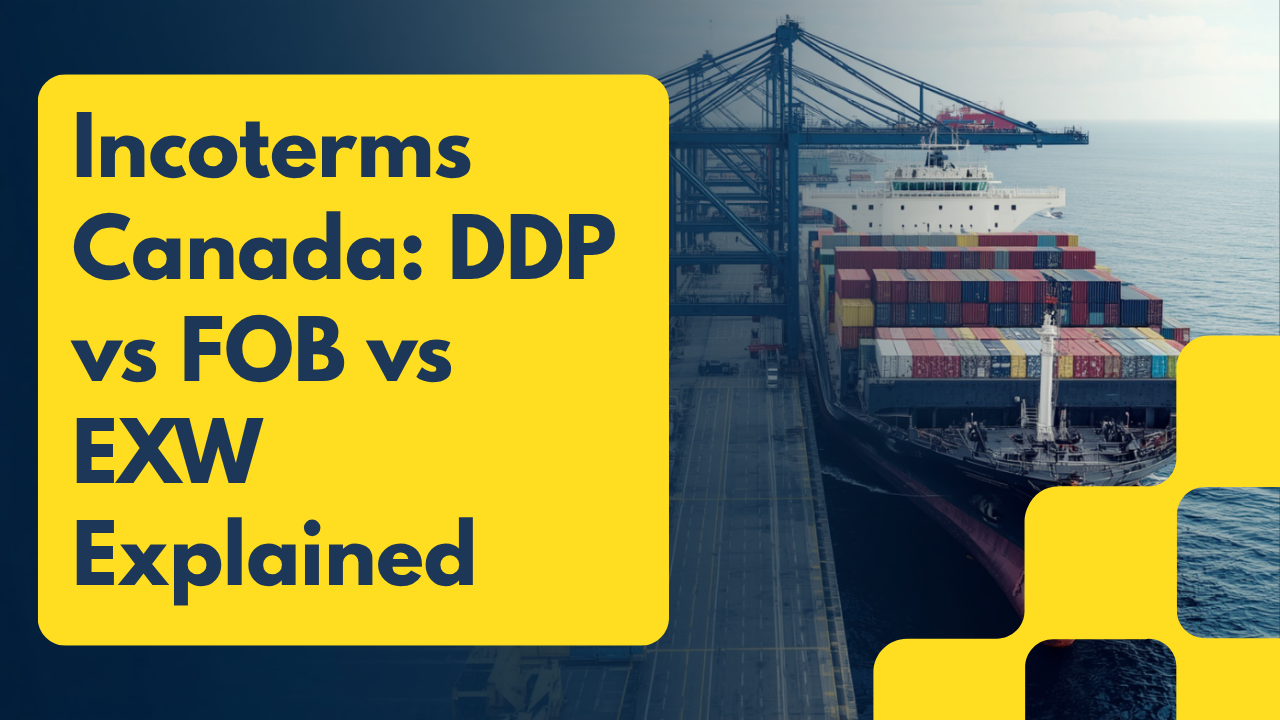
If you've gotten a quote from a Chinese supplier and seen "FOB Shanghai" or "EXW factory" next to the price, you've run into Incoterms — and getting them wrong is one of the most common (and expensive) mistakes Canadian importers make. Incoterms Canada questions come up constantly with first-time importers because the difference between EXW, FOB, and DDP isn't just paperwork — it determines who pays for freight, who's responsible for the goods at each stage, and who's on the hook if something goes wrong in transit.
Misreading an Incoterm can turn a "great deal" into a shipment that costs thousands more than expected once freight, insurance, and customs clearance are added on top of what you thought was the final price.
This guide breaks down the Incoterms Canadian importers actually encounter when sourcing from China, walks through how each one affects your real landed cost, and flags the mistakes that trip up first-time importers most often — so you can read a supplier quote with confidence instead of guessing at what's actually included.
Incoterms (International Commercial Terms) are a standardized set of trade terms published by the International Chamber of Commerce. They define exactly where the seller's responsibility ends and the buyer's begins — covering who arranges shipping, who pays for it, who insures the goods, and at what point risk transfers from supplier to buyer.
There are 11 Incoterms in total, but Canadian SME importers sourcing from China will realistically only deal with three or four of them on a regular basis: EXW, FOB, DDP, and occasionally CIF or DAP.
Under EXW, the supplier's responsibility ends the moment your goods are ready for pickup at their factory door. You (or your freight forwarder) arrange and pay for everything from that point forward: loading, export customs clearance in China, ocean or air freight, import customs clearance in Canada, duties, and final delivery.
EXW quotes look the cheapest on paper because they only reflect the product cost, not the logistics. For a first-time importer without a freight forwarder relationship already in place, EXW can turn into a logistical headache — you're responsible for coordinating pickup, export documentation, and customs in a country where you likely don't have boots on the ground.
FOB is the most common term Canadian importers deal with, and for good reason — it splits responsibility at a clear, practical point. Under FOB, the supplier handles getting your goods to the port and loaded onto the vessel, including export customs clearance in China. Once the goods are on board, responsibility (and cost) shifts to you for ocean freight, import clearance, duties, and delivery to your warehouse.
FOB works well because the supplier already has the local relationships and knowledge to handle domestic transport and export paperwork efficiently, while you retain control over choosing your own freight forwarder and negotiating international shipping rates — which can vary significantly between providers.
DDP puts nearly everything on the supplier's plate: freight, insurance, import customs clearance, and duties, with the goods delivered straight to your door. For a business new to importing, DDP looks attractive because there's a single, all-in price and minimal hands-on logistics work.
The trade-off is control and cost transparency. DDP quotes often bake in a markup on freight and customs handling that you can't easily verify, and if your supplier misclassifies your goods or under-declares value for customs purposes to keep the price attractive, you — as the importer of record — can still be liable for the shortfall if Canadian customs catches the discrepancy later. DDP can be the right call for smaller, simpler shipments where convenience outweighs the cost of losing visibility into the process.
Choose EXW if you already have a freight forwarder and want maximum control (and are comfortable with the added coordination work).
Choose FOB if you want a balance of cost control and manageable logistics — this is the default recommendation for most growing Canadian importers.
Choose DDP if you're placing a smaller, simpler order and value convenience over having full visibility into freight and customs costs.
Whichever term you use, always get the quote broken down by component (product cost, freight, insurance, duties) rather than accepting a single bundled number — it's the only way to compare quotes apples-to-apples across suppliers. For the fuller step-by-step process, see our complete guide to importing from China to Canada.
Your landed cost — the true, all-in cost of getting a product to your warehouse — depends heavily on which Incoterm you're working under. An EXW quote of $5 per unit and an FOB quote of $6 per unit for the same product might result in the exact same landed cost once you factor in who's paying for domestic trucking and export handling in China. The mistake most new importers make is comparing headline unit prices across suppliers without normalizing for the Incoterm each one is quoting under.
Before committing to a supplier, always ask: what Incoterm is this price based on, and what would the full landed cost look like under FOB terms specifically, since that's the easiest baseline for apples-to-apples comparison? This same principle applies whether you're importing full container loads or consolidating smaller parcels — our guide to buying and shipping from Taobao to Canada covers how landed cost adds up on smaller cross-border orders too.
Regardless of which Incoterm you use, Canadian duties and GST (plus provincial sales tax in some cases) apply once your goods clear customs — the Incoterm only determines who's responsible for arranging and paying that clearance, not whether it's owed. Duty rates vary by HS code and country of origin, and getting the classification wrong is a separate — and equally costly — mistake from misunderstanding Incoterms. If you haven't already worked through how duties and GST are calculated for your specific product category, our guide to import duties, taxes, and GST in Canada is worth reading alongside your Incoterm decision, not after.
Beyond EXW, FOB, and DDP, two other terms show up regularly enough in Canadian import quotes to be worth knowing. CIF (Cost, Insurance, and Freight) means the supplier pays for ocean freight and insurance to your destination port, but you're still responsible for import clearance and delivery from the port onward — think of it as FOB with freight and insurance bundled in. DAP (Delivered at Place) means the supplier delivers the goods to your specified location, but you handle import duties and clearance yourself — essentially DDP minus the duty payment.
Both terms are worth negotiating for if a supplier's default FOB or DDP quote isn't giving you the balance of cost and control you want.
To make this concrete, here's how the same order might break down under three different Incoterms. Say you're importing a container of goods with a $10,000 product cost:
Under EXW: $10,000 product cost + $400 domestic trucking in China + $300 export clearance + $2,200 ocean freight + $150 marine insurance + $1,200 Canadian duties and GST + $500 customs brokerage = roughly $14,750 landed cost, but you're coordinating five separate vendors to get there.
Under FOB: $10,700 product cost (trucking and export clearance already included by the supplier) + $2,200 ocean freight + $150 insurance + $1,200 duties and GST + $500 brokerage = roughly $14,750 landed cost — the same total, but with far less coordination on your end since the supplier handles everything up to the port.
Under DDP: A single quoted price of, say, $15,800 that bundles everything, including the supplier's markup for managing freight and customs — often 5-10% more than the itemized FOB total, in exchange for zero hands-on logistics work.
The lesson here isn't that one Incoterm is inherently cheaper — it's that the total landed cost should end up in a similar range regardless of term, and any large gap between quotes under different Incoterms is worth questioning.
Accepting a DDP quote without verifying the customs value declared. If a supplier under-declares value to lower your duty bill, you're still legally responsible as importer of record.
Assuming FOB includes insurance. It doesn't — FOB only covers goods to the port. Cargo insurance for the ocean or air leg is a separate line item you need to arrange.
Not confirming which port "FOB" refers to. "FOB" alone is incomplete — it should always specify a named port (e.g., "FOB Ningbo"), since freight costs vary significantly by departure port.
Treating Incoterms as fixed rather than negotiable. Many suppliers will quote whichever Incoterm is easiest for them by default. It's reasonable to ask for a quote under a different term if it gives you better cost visibility or control.
What's the safest Incoterm for a first-time importer?
FOB is generally the best starting point — it gives you meaningful cost control without requiring you to manage export logistics in China directly.
Is DDP always more expensive than FOB?
Not necessarily on paper, but DDP quotes often include hidden markups on freight and customs handling that are harder to verify than an itemized FOB-plus-freight quote.
Who is responsible for customs delays under FOB?
Once goods are loaded FOB, the buyer (you, or your customs broker acting on your behalf) is responsible for import clearance in Canada and any resulting delays.
Do Incoterms determine who pays duties?
Not directly — duties are always owed to the Canadian government based on the goods' classification and value. Incoterms determine who arranges and fronts that payment as part of the shipping process.
Can I negotiate the Incoterm with my supplier?
Yes. Incoterms are a starting point for quoting, not a fixed rule — most suppliers can requote under EXW, FOB, or DDP if you ask.
Do Incoterms change every year?
The ICC updates the official Incoterms rulebook periodically (the most recent major revision was Incoterms 2020), but the core terms Canadian importers use most — EXW, FOB, and DDP — have stayed conceptually consistent across revisions. Always confirm with your supplier and freight forwarder which version of the rules they're quoting under, since minor definitional changes can affect liability in edge cases.
Choosing the right Incoterm is one small piece of a much bigger import puzzle — supplier vetting, freight negotiation, customs compliance, and quality control all factor into your true landed cost. Our team handles that end-to-end so you're not left decoding trade terms on your own.
Talk to Epic Sourcing Canada about your next shipment and we'll help you find the Incoterm and freight setup that actually makes sense for your business.