Sourcing agents and freight forwarders play completely different roles in your import process. Here's how to tell them apart, when you need each, and whether you need both.
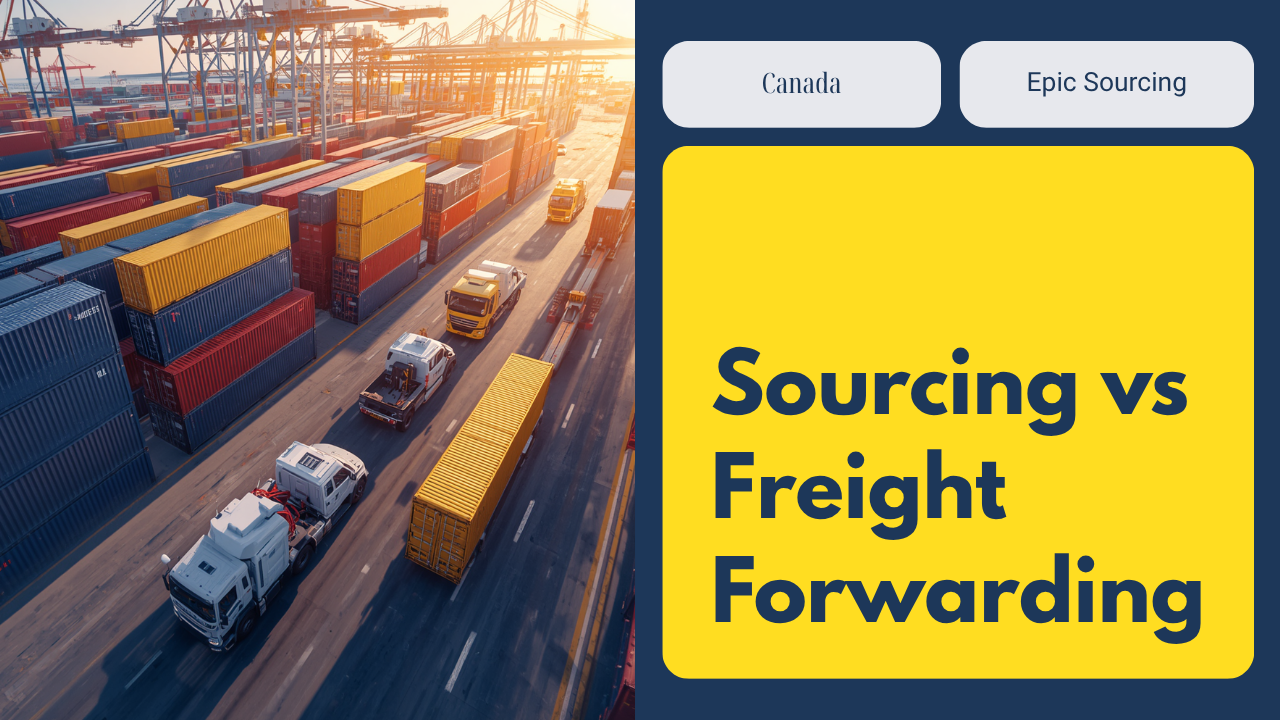
If you're importing goods from China to Canada for the first time, you'll quickly run into two types of service providers that sound related but do very different things: freight forwarders and sourcing agents. A lot of first-time Canadian importers assume these roles overlap — or worse, hire only one when they actually need both.
This guide breaks down exactly what each does, where their responsibilities end, and how to decide which one you need for your import situation. Getting this wrong is one of the most common and expensive mistakes new importers make.
A freight forwarder is a logistics specialist. Their job starts when your goods are ready to ship at the factory and ends when they've cleared Canadian customs and been delivered to your door or warehouse.
A good freight forwarder china to canada will handle booking ocean or air freight space with carriers, coordinating pickup from the factory or port, preparing export documentation including the commercial invoice, packing list, and bill of lading, tracking the shipment in transit, arranging Canadian customs clearance (typically through a licensed customs broker partner), and organising final delivery to your Canadian address.
A freight forwarder is not responsible for whether you've chosen the right factory, whether the product quality is acceptable, or whether the goods comply with Canadian regulations. Their job is to move your cargo — not vet your supplier.
A sourcing agent is a product and supplier specialist. Their job starts before a single item is manufactured and typically ends when goods are confirmed ready to ship — or in some cases, once they've arrived and been inspected on your end.
A professional sourcing agent for Canadian importers will handle identifying qualified factories for your product specification, getting competitive quotes from multiple suppliers, vetting factory credentials and compliance documentation, managing sample development and approval, placing and managing purchase orders, conducting or coordinating pre-shipment quality inspections, and advising on compliance requirements for the Canadian market.
A sourcing agent typically does not book freight or clear your goods through Canadian customs — that's the freight forwarder's domain. Some sourcing agents have freight partnerships and can coordinate the full handoff, but the roles are distinct.
The cleanest way to understand this is to think of the import process as a timeline with a clear handoff point:
Sourcing agent
The sourcing agent owns the supplier relationship, product quality, and production readiness. The freight forwarder owns the physical movement of goods from factory gate to your warehouse in Canada. They hand off at the point of cargo readiness — usually after a pre-shipment inspection is completed and the supplier has issued the commercial invoice.
This is also where first-time importers most commonly fall through the cracks — the gap between production completion and freight booking, where documentation errors, missing compliance paperwork, or quality issues surface. Having clear responsibility on both sides closes that gap.
You need a sourcing agent when you don't already have established supplier relationships in China or Vietnam, when you're sourcing a product for the first time and need factory vetting and price comparison, when your product has custom specifications, private labelling, or branding requirements, when you need someone on the ground to manage quality control before goods ship, or when you want genuine protection — someone who speaks the language, knows the manufacturing culture, and represents your interests directly rather than just passing your order through.
If you already have reliable suppliers you've ordered from multiple times and trust, you may not need full sourcing agent services for every order. But for first-time importers or new product categories, skipping this step is one of the most expensive decisions Canadian businesses make.
You need a freight forwarder canada for essentially every commercial import. Trying to manage international shipping yourself — with carrier bookings, export documentation, customs declarations, and delivery coordination — is extremely time-consuming and error-prone without industry relationships and expertise.
A good freight forwarder will get you better freight rates than you can access directly as a one-time shipper, prevent documentation errors that cause customs holds, navigate CBSA requirements so your paperwork is correct the first time, and give you real-time visibility into your shipment status.
Some freight forwarders also have in-house customs brokers or established broker partnerships — useful for streamlining the Canadian customs clearance process. If you haven't dealt with CBSA's CARM system yet, our CARM 2026 guide for Canadian importers is worth reading before your first shipment arrives.
For most Canadian businesses importing from China or Vietnam for the first time, the answer is yes — you need both. They serve completely different functions and neither replaces the other.
Here's where the confusion arises: some sourcing agents have freight partnerships or in-house logistics teams, and some freight forwarders have in-house sourcing or procurement capabilities. The overlap exists at the edges, but the core competencies don't duplicate. A freight forwarder's contact in Shenzhen is not the same as an experienced sourcing agent who knows your product category, has real factory relationships, and can negotiate terms and QC requirements on your behalf.
The best-case scenario is a sourcing partner who coordinates both — managing your supplier relationship through production, then handing off to freight with all documentation in order. This reduces the gap where first-time importers most often get hurt.
Skipping the sourcing agent to save money is the more common mistake — and it's almost always more expensive than what the agent would have cost. Common outcomes when Canadian importers source directly without experienced support include receiving goods that don't match the approved samples, wrong bilingual labelling that must be redone before products can be sold, paying above-market FOB prices because there was no one to negotiate, factory substitution where you think you're buying from one facility but production is contracted to a third party, and missing Canadian product compliance requirements from bodies like Health Canada, ISED, or CSA.
These aren't edge cases. They happen regularly to first-time importers who focus heavily on the product margin and underestimate the value of experienced eyes on the production side. For more on what can go wrong and how to protect yourself, read our guide on what to do when your Chinese factory ships defective goods to Canada.
Not all freight forwarders are created equal. When evaluating options for China-to-Canada shipments, look for physical presence in China — a forwarder with offices or agents in major Chinese export cities like Shanghai, Shenzhen, Ningbo, and Guangzhou handles origin pickup and export documentation far more smoothly than one relying entirely on third-party agents.
Also look for strong Canadian customs expertise. Your forwarder should either have an in-house licensed customs broker or a strong broker partnership, since CBSA declarations require precision. Confirm they have a track record with your cargo type, whether that's FCL container loads, LCL consolidations, or air freight. And always ask for itemised pricing — quotes should break out origin charges, ocean freight, destination charges, and customs fees separately.
A great sourcing agent for Canadian importers should have an established team or network of vetted contacts in the relevant manufacturing region, understand Canadian compliance requirements (not just manufacturing realities), charge transparent fees rather than hiding margin in the supplier price, be willing to provide references from other Canadian clients, and have genuine product category expertise rather than just access to a generic supplier database.
Be cautious of “sourcing agents” who are essentially middlemen without real factory access. You want someone who can walk into a factory, communicate directly with the production manager in Mandarin or Vietnamese, and represent your interests without a conflict of interest built into the fee structure.
Some freight forwarders offer procurement or sourcing services as an add-on, but it's not their core competency. For complex products, custom manufacturing, or private label projects, a dedicated sourcing agent will give you far better supplier selection and quality control outcomes than a logistics company operating outside its wheelhouse.
Sourcing agents typically charge a flat service fee per project or a percentage of the total order value, usually between 5 and 10%. Some also charge an initial research or vetting fee. Avoid agents who make their money entirely from supplier commissions — it creates a conflict of interest where their incentive is to maximise order value rather than find you the best supplier.
Alibaba gives you access to supplier listings, but it doesn't vet factory quality, negotiate on your behalf, or manage production. Many Canadian importers start on Alibaba and then bring in a sourcing agent after experiencing a bad order. Starting with a sourcing agent is almost always cheaper than recovering from a failed direct import.
A customs broker is licensed by CBSA to prepare and submit import declarations on your behalf. A freight forwarder handles the physical movement of goods. Many freight forwarders partner with or employ licensed customs brokers to offer an integrated service. For your first Canadian import, you'll need both functions covered. Check out our guide on what a customs broker is and whether you need one for more detail.
Yes — Epic Sourcing Canada manages the process from supplier identification and quality control through to freight coordination and Canadian customs clearance preparation. We make sure the handoff between sourcing and shipping is seamless so nothing falls through the cracks between your factory in Asia and your warehouse in Canada.
If you're trying to figure out which combination of services you actually need for your first (or next) import from China or Vietnam to Canada, that's exactly the kind of question we work through with clients every day.
Epic Sourcing Canada works with Canadian businesses at every stage — from initial product research and supplier selection through factory vetting and quality inspection to freight coordination and customs clearance documentation. We know the freight forwarder network and we know the factories. You don't have to manage two separate relationships across two different time zones while also running your business.
Book a free discovery call and let's map out exactly what your import needs.