Why supply chain resilience is now a survival skill for Canadian importers, and a practical, low-disruption way to diversify sourcing beyond a single country in 2026.

If you're a Canadian business owner who sources products from overseas, "supply chain resilience" has probably stopped being a buzzword and started being a Tuesday-morning problem. A supplier misses a shipment. A tariff changes overnight. A single factory that makes 80% of your SKUs goes quiet for two weeks during a regional holiday you didn't know existed. Supply chain resilience is the ability to keep your business running when any one of those things happens — and in 2026, with trade policy shifting faster than most import calendars can keep up, it's no longer optional for Canadian importers who rely on a single country or a single supplier.
This isn't a theoretical exercise. Canadian SMEs that leaned entirely on one manufacturing region over the past few years have felt real margin pressure from freight volatility, tariff changes, and factory capacity crunches. The businesses that came out ahead weren't the ones with the cheapest unit cost — they were the ones that could pivot. This guide breaks down what supply chain resilience actually means for a Canadian importer, why diversifying your sourcing base matters in 2026, and how to do it without blowing up your timelines or your margins.
For the better part of two decades, "sourcing strategy" for most Canadian SMEs meant finding one good factory in China, building a relationship, and running the same playbook for years. That approach worked when shipping was predictable, tariffs were stable, and geopolitical risk felt like someone else's problem. None of those three things are reliably true anymore.
Canada's trade relationship with China has gone through real changes, and importers who didn't have a plan B found themselves absorbing tariff costs, renegotiating supplier terms under pressure, or scrambling to find alternative capacity mid-season. Add in freight rate swings, container shortages that flare up unpredictably, and factory lead times that can stretch from 30 days to 60 without warning, and it becomes clear why resilience — not just cost — needs to be a core part of how Canadian businesses think about sourcing.
Supply chain resilience means your business can absorb a shock — a tariff hike, a shipping delay, a supplier failure — without it becoming an existential problem for your product line. It's built through redundancy, visibility, and relationships, not through finding the single lowest-cost option and hoping nothing changes.
Concentrating your entire supply chain in one country creates a few specific vulnerabilities that Canadian importers consistently underestimate:
Tariff exposure. When trade policy shifts between Canada and a specific origin country, importers with all their eggs in that basket absorb the full impact. Businesses with even one alternative sourcing region can shift volume and cushion the hit.
Capacity bottlenecks. Factories in any single manufacturing hub compete for the same raw materials, the same skilled labour, and the same shipping lanes. During peak season, that competition drives up lead times and prices for everyone sourcing from that region.
Single points of failure. If your primary factory has a quality issue, a labour dispute, or simply decides to stop taking your order volume, and you have no qualified backup, your product line stops. Not slows down — stops.
Currency and freight volatility. Concentrating shipping volume on one trade lane means you're fully exposed to freight rate spikes on that specific route, with no ability to compare or shift.
None of this means your current supplier is bad, or that sourcing from China (or anywhere else) is a mistake. It means that resilience comes from having options, not from having the one perfect supplier.
A resilient supply chain for a Canadian SME doesn't require ripping up existing supplier relationships or doubling your sourcing team. In practice, it usually comes down to four things:
1. A qualified second source for your highest-volume SKUs. You don't need a backup supplier for every product — you need one for the products that would hurt the most if they stopped shipping.
2. Documentation that travels. Specs, quality standards, and compliance requirements should be written down clearly enough that a new factory could pick up production without months of back-and-forth. If your entire product knowledge lives in one supplier's head, that's a risk, not a relationship.
3. Visibility into your landed cost, not just your unit cost. Resilience decisions are cost decisions. You can't compare a second sourcing country fairly if you're only looking at factory price and not freight, duty, and compliance costs.
4. A relationship with someone who has boots on the ground in more than one region. This is where a lot of Canadian importers get stuck — they know diversification is smart, but they don't have the on-the-ground relationships to vet a new supplier in a country they've never sourced from.
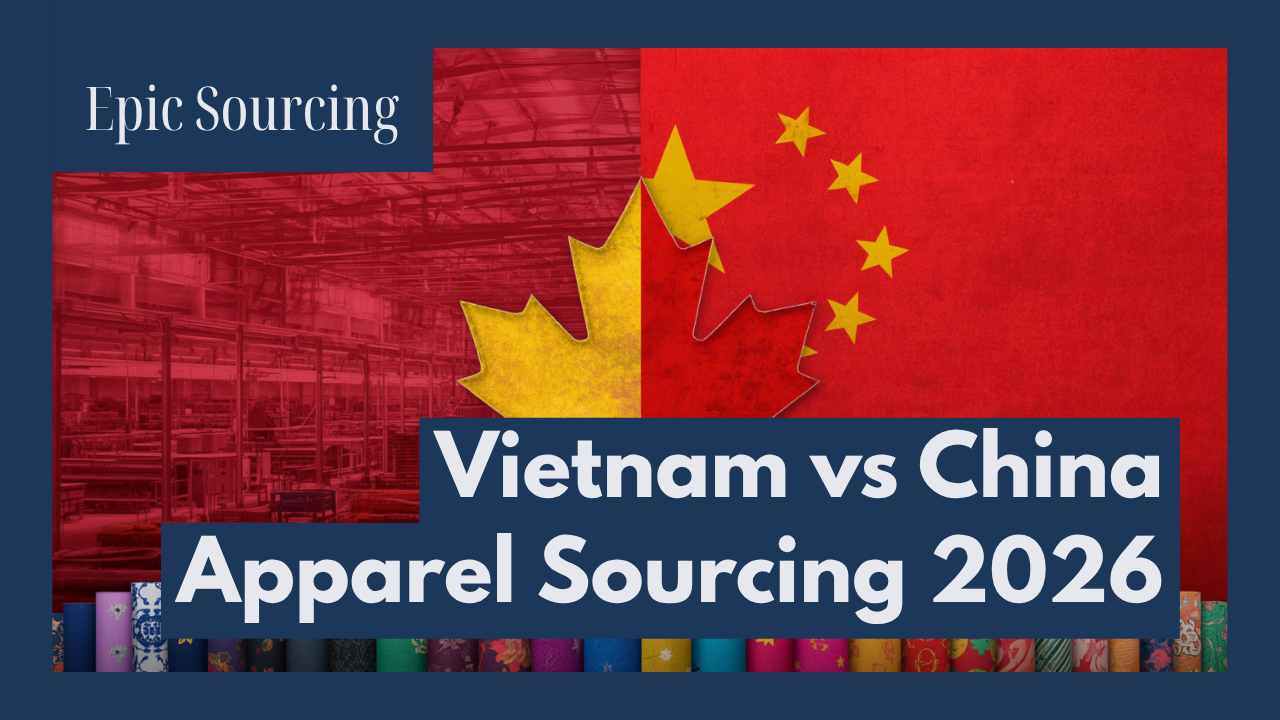
The most common and most practical way Canadian importers are building resilience in 2026 is what's known as a "China+1" strategy — keeping an existing China supplier relationship while qualifying a second manufacturing base, often in Vietnam, for at least part of the product line.
Vietnam has become the default second option for a reason. Under CPTPP, Canadian businesses importing from Vietnam to Canada can access preferential duty treatment that isn't available on equivalent Chinese-made goods, which partially offsets the higher factory pricing you'll typically see compared to Chinese manufacturers. Combine that with lower labour costs relative to coastal Chinese manufacturing hubs and steadily improving factory infrastructure, and it's easy to see why Canadian brands are shifting toward Vietnam sourcing as their diversification play.
This doesn't mean Vietnam is the right second market for every product category — factory capability still varies significantly by product complexity, and not every Chinese-made SKU has an equivalent-quality Vietnamese option yet. But for apparel, home goods, and many consumer product categories, it's a proven path.
The biggest fear Canadian importers have about diversifying sourcing is time. Qualifying a new factory, running samples, negotiating terms, and building trust can feel like a six-month distraction from actually running your business. It doesn't have to be that disruptive if you sequence it correctly.
Start with your product line's biggest volume or biggest risk SKU — not your whole catalogue. Run the new supplier in parallel with your existing one rather than switching cold turkey. Order a modest first production run to test quality and communication before committing meaningful volume. And use the process as an opportunity to tighten your own spec sheets and QC documentation, which will pay off even if you never end up needing the second supplier.
This is also where working with an experienced sourcing agent shortens the timeline considerably. A sourcing partner who already has vetted factory relationships in more than one country can compress a process that would normally take months of cold outreach and factory visits into a matter of weeks.
Whether you're adding a second country or simply qualifying a backup factory within your existing sourcing region, the evaluation criteria are largely the same:
Production capability match. Can the factory actually produce your product to spec, or are you looking at a trading company that will subcontract it out without telling you?
Compliance and certification readiness. Does the factory understand Canadian labelling, safety, and certification requirements, or will you be starting compliance education from scratch?
Realistic lead times, not quoted lead times. Ask for lead times on your actual product and order volume, not generic factory averages.
Landed cost, fully loaded. Factor in freight, duty (including any preferential trade agreement treatment), and the cost of managing an additional supplier relationship before comparing it against your current sourcing.
Communication and responsiveness during the sampling phase. How a factory handles your first round of samples and revisions tells you almost everything about how they'll handle a real production issue down the line.
The most common mistake is treating diversification as an all-or-nothing decision — trying to move an entire product line to a new country at once instead of testing with a single SKU. The second is choosing a new sourcing country based purely on unit price without accounting for the fully landed cost, including duty treatment under agreements like CPTPP or CUSMA. The third, and probably the most damaging, is diversifying without documenting specs and QC standards first, which means the new supplier inherits all the same tribal knowledge gaps that made the original relationship fragile in the first place.
What does supply chain resilience actually mean for a small Canadian importer?
It means your business can keep shipping product even if one supplier, one country, or one shipping lane runs into trouble. In practice, that usually comes down to having a qualified backup supplier for your highest-risk SKUs and clear documentation that isn't locked inside one factory relationship.
Do I need to diversify away from China completely?
No. Most successful Canadian importers keep their existing China relationships and add a second country for part of their product line — a "China+1" approach — rather than replacing suppliers wholesale.
How long does it take to qualify a second sourcing country?
With a clear spec sheet and an experienced sourcing partner, a first qualified production run in a new country can often happen within 8-12 weeks, though full confidence typically builds over two to three production cycles.
Is Vietnam always the right second sourcing country?
It's the most common choice for apparel, home goods, and many general consumer products because of CPTPP duty treatment and improving factory infrastructure, but it isn't universal. Some product categories still have stronger, more mature capability in China or other regions.
What's the biggest risk of not diversifying?
Being unable to fulfill orders if your single supplier or single country faces a disruption — whether that's a tariff change, a capacity crunch, or a factory-specific problem. The cost of a stockout or a lost customer relationship is usually far higher than the cost of qualifying a backup supplier.
Building real supply chain resilience takes more than good intentions — it takes on-the-ground relationships in more than one manufacturing region, a clear-eyed view of your fully landed costs, and a process for qualifying new suppliers without disrupting the orders you already have moving. That's exactly what Epic Sourcing Canada does for importers who are ready to stop depending on a single point of failure.
Whether you're exploring a China+1 strategy, evaluating offshore manufacturing options for the first time, or just want a second opinion on how exposed your current sourcing setup really is, our team can help you build a plan that fits your product line and your timeline. Get in touch with Epic Sourcing Canada to start building a more resilient sourcing strategy for 2026 and beyond.