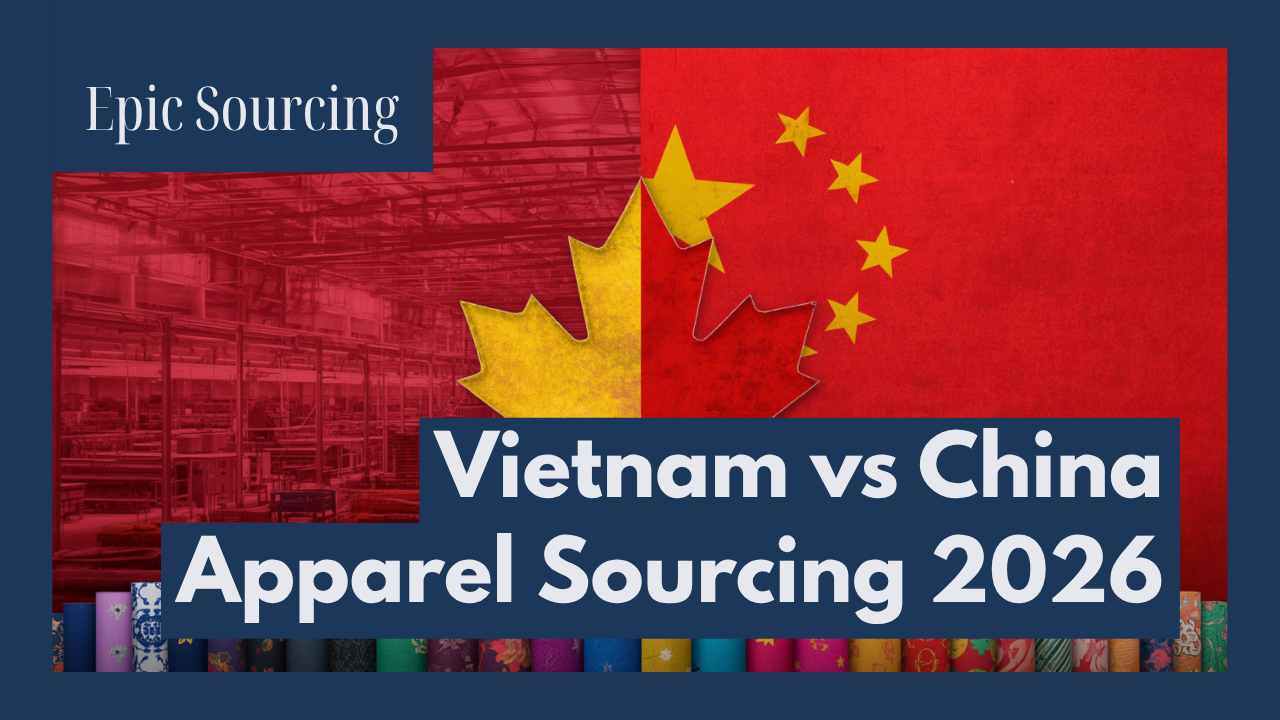
A side-by-side comparison of Vietnam and China for Canadian importers, covering costs, tariffs, product fit, and supply chain risk.
Many Canadian businesses are rethinking their reliance on China for manufacturing. The idea of a China Plus One strategy has moved from boardroom talk to actual execution for importers of all sizes. Vietnam is the most common alternative, but how does it really stack up against China for Canadian importers? This guide breaks it down across the factors that matter most: cost, tariffs, product fit, quality, lead times, and risk.
Vietnam's manufacturing wages are roughly 30 to 50 percent lower than China's in many sectors. For labour-intensive products like garments, footwear, and assembled consumer goods, this difference can meaningfully reduce your per-unit production cost.
The tariff advantage is equally significant. Under CPTPP, many Vietnamese-made goods enter Canada at zero or reduced duty. Chinese imports do not benefit from this agreement. Depending on the product category, the tariff difference alone can be 5 to 18 percent of the goods value, which on a large order translates to thousands of dollars in savings.
Vietnam excels in labour-intensive manufacturing. If your product involves sewing, assembly, woodworking, or light fabrication, Vietnam is likely a strong fit. Apparel, footwear, bags, furniture, and basic consumer goods are well-established production categories.
China retains advantages in complex electronics, heavy machinery, precision tooling, and products that require deep supply chain integration with hundreds of component suppliers. If your product needs advanced injection moulding, complex PCBs, or very high-volume runs with tight tolerances, China's manufacturing ecosystem is still hard to beat.
For many Canadian importers, the best approach is not choosing one over the other but using both strategically. Source what Vietnam does well from Vietnam, and keep complex or highly integrated products in China.
Quality and Reliability
Vietnam's manufacturing quality has improved dramatically over the past decade. Many factories now hold ISO certifications and supply major international brands. However, quality consistency can still vary, especially with smaller or newer suppliers. This is where having a sourcing agent with on-the-ground presence matters. Regular factory visits and pre-shipment inspections catch issues before goods leave Vietnam.
China still has the edge in deep manufacturing expertise for complex products. But for standard consumer goods, Vietnam's quality is increasingly competitive, especially when proper QC processes are in place.
Lead Times and Logistics to Canada
Sea freight from Vietnam to Vancouver typically takes 18 to 22 days, while shipments to Montreal or Toronto via the East Coast route take 28 to 35 days. From China, transit times to Vancouver are 12 to 18 days, giving China a slight logistics advantage for West Coast Canadian importers.
However, the total lead time difference is often smaller than expected once you factor in production time. Vietnamese factories may have shorter production queues for mid-volume orders, which can offset the slightly longer transit.
Why Risk Diversification Matters for Canadian Importers
Relying on a single country for all your manufacturing creates concentration risk. Geopolitical tensions, trade policy changes, natural disasters, and pandemic disruptions have all demonstrated the dangers of a single-source supply chain. Adding Vietnam as a sourcing destination gives your business resilience and flexibility.
Compare Your Options with Expert Help
Every product and business is different. The right sourcing destination depends on your product type, order volume, quality requirements, and budget. Epic Sourcing has teams on the ground in both China and Vietnam, and we work with Canadian businesses to determine the best manufacturing strategy for each product line. Book a free Vietnam vs China sourcing consultation to get tailored advice for your business.