Canada's trade surplus is shifting currency, freight, and policy conditions that affect small importers. Here's what's changing and how to adapt sourcing in 2026.
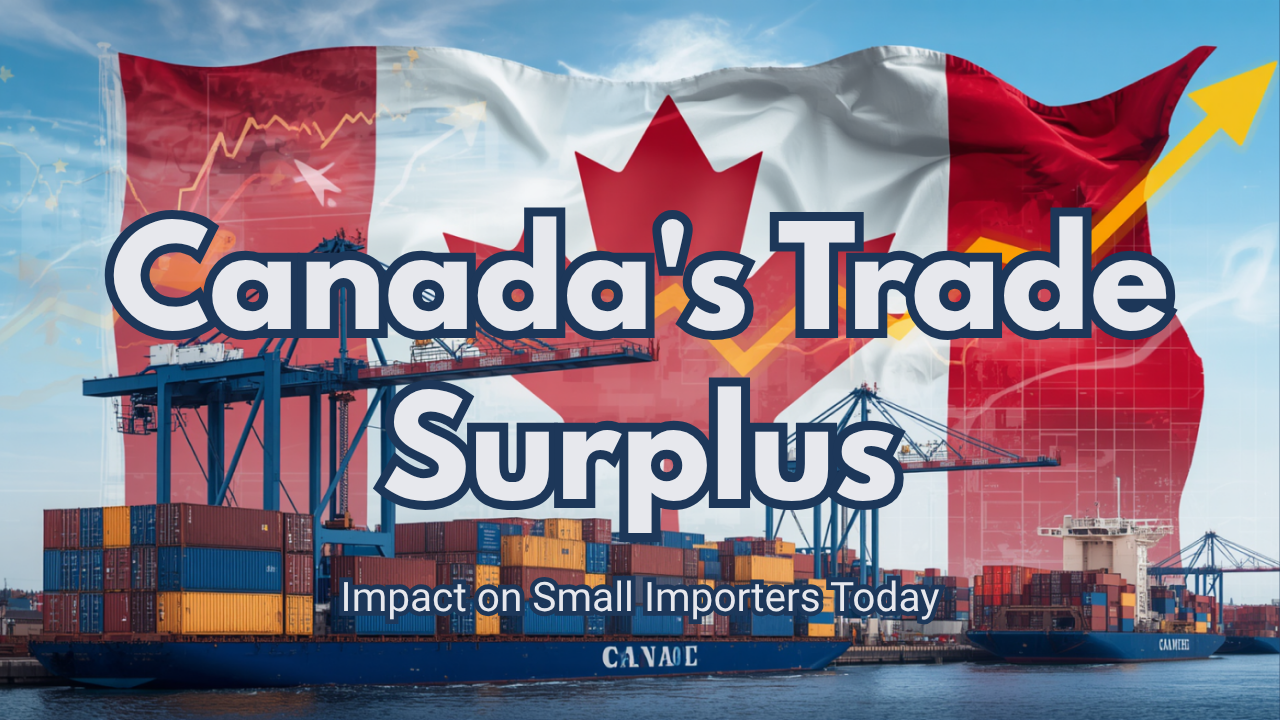
Canada posted another trade surplus this year, and for most small business owners the headline barely registered. But behind the canada trade surplus numbers is a set of supply chain shifts that are already changing how small importers source, ship, and price their products — and the businesses paying attention now are the ones adapting fastest.
This isn't abstract macroeconomics. A trade surplus changes currency strength, freight capacity, and which trade lanes get prioritized by carriers — all of which hit your landed cost before you've noticed anything changed on the news.
A trade surplus simply means Canada is exporting more (by value) than it's importing. Recent surpluses have been driven largely by energy, metals, and agricultural exports, alongside a slower pace of consumer goods imports as businesses worked through inventory built up in previous years. None of that sounds like it should touch a small importer bringing in home goods, apparel, or wellness products from overseas — but it does, in three specific ways.
First, a stronger trade position tends to support a stronger Canadian dollar relative to trading partners, which changes your purchasing power on every USD-denominated supplier invoice. Second, when exports are strong, ocean and air carriers reallocate capacity toward the routes carrying those exports, which can tighten availability and shift pricing on the import side. Third, government trade policy attention follows the surplus categories — meaning sourcing categories outside those sectors sometimes get less regulatory support and more scrutiny by comparison.
Small importers tend to assume macro trade data is someone else's problem — a topic for economists and exporters, not for the business bringing in 500 units of a product from a factory overseas. In practice, the ripple effects show up in three very practical places.
Currency exposure. If you're paying suppliers in USD or RMB, a shift in the Canadian dollar's relative strength changes your cost of goods before a single tariff or duty is applied. A currency move of even 3-4% can wipe out a thin margin on a low-cost category.
Freight capacity and pricing. Carriers optimize for their most profitable lanes. When Canadian exports are strong, backhaul capacity on import lanes can loosen (good for you) or tighten (bad for you), depending on the specific trade lane and vessel rotations. This is why freight quotes can swing meaningfully quarter to quarter even when nothing in your own order has changed.
Policy and compliance attention. Trade surpluses often accompany renewed trade negotiations, as we've seen with recent shifts in Canada-China trade discussions. If you're curious how a live trade negotiation can directly change your sourcing costs, it's worth reading our breakdown of the Canada-China trade deal and what it means for importers.
If you're running a small import business — whether that's private label home goods, apparel, pet products, or electronics — the trade surplus environment translates into a few concrete realities in 2026:
Your landed cost is less predictable quarter to quarter. Currency and freight volatility mean the quote you got in January isn't a reliable basis for your Q3 pricing. Businesses that build in a buffer (or renegotiate terms more frequently) are protecting margin better than those locked into fixed annual pricing assumptions.
Diversified sourcing is paying off for the businesses that already did it. Importers who spread sourcing across more than one country or region are absorbing currency and freight shocks better than single-country importers. We've written in more depth about this in our guide to building supply chain resilience through sourcing diversification.
Small importers have less pricing power than large retailers. When freight and currency costs rise, big-box retailers can absorb short-term hits or push back on suppliers. Small importers usually can't — which makes it more important to understand your true landed cost (not just unit price) before committing to a purchase order.
1. Continued diversification away from single-country dependency. More Canadian brands are adding a second or third sourcing country — often Vietnam, India, or Mexico alongside China — specifically to reduce exposure to any single currency, tariff regime, or trade negotiation outcome. This isn't about abandoning China; it's about not having 100% of your product line exposed to one country's trade relationship with Canada.
2. Freight rate volatility becoming the norm, not the exception. Ocean freight rates have swung by 30-50% within single-year windows multiple times in the past few years. Importers who build freight volatility into their pricing models — rather than treating it as a one-time shock — are the ones staying profitable.
3. Compliance and customs scrutiny increasing on certain import categories. As trade negotiations shift focus toward specific sectors, customs enforcement attention often follows. Making sure your CARM registration, tariff classifications, and documentation are current isn't optional busywork anymore — it's risk management. Our CARM guide for Canadian SMEs walks through what's required.
You don't need to become a trade economist to protect your business. A few practical moves make the biggest difference:
Get your true landed cost, not just your unit price. Factor in current freight rates, duty rates, currency conversion, and customs brokerage fees before you commit to volume. A supplier quote in isolation tells you very little.
Build a second sourcing option before you need one. Waiting until your primary supplier or country becomes unworkable is the most expensive time to start diversifying. Vetting a backup supplier — even if you don't use them yet — is cheap insurance.
Reassess your Incoterms. Whether you're buying FOB, EXW, or DDP changes who absorbs freight volatility. If you're not sure which term protects you best right now, our FOB vs EXW vs DDP guide breaks down the tradeoffs for Canadian importers specifically.
Work with someone who's watching the macro picture for you. Most small business owners don't have time to track trade negotiations, currency movements, and freight indices on top of running their business. That's exactly the gap a sourcing partner should be filling.
The most common mistake is treating trade policy as background noise until it directly hits an invoice. By the time a currency shift or tariff change shows up in your landed cost, it's too late to renegotiate terms for the order already in production.
The second most common mistake is over-correcting — panic-moving an entire product line to a new country without properly vetting the new supplier, checking compliance requirements, or running a pilot order first. A rushed sourcing pivot often costs more in quality issues and delays than the trade shift it was meant to avoid.
Does a Canadian trade surplus make imports cheaper or more expensive?
It depends on the currency and freight effects, which don't move in a single predictable direction. A stronger Canadian dollar (often associated with surplus periods) can make USD-priced imports cheaper, while tighter freight capacity on certain lanes can offset that gain.
Should small importers care about macro trade data at all?
Yes — not to predict the market, but to understand why costs are moving. Importers who understand the "why" behind a freight or currency shift can react faster than those who only see the impact on their invoice.
Is now a good time to diversify sourcing away from a single country?
Most sourcing experts, including our team, recommend treating diversification as an ongoing practice rather than a reaction to a single news cycle. The businesses in the best position today started diversifying before they needed to.
How often should I re-check my landed cost assumptions?
At minimum, quarterly — more often if you're importing high volumes or operating on thin margins. Freight and currency conditions can shift meaningfully within a single quarter.
What's the fastest way to know if my current sourcing setup is exposed to trade risk?
Start with a simple audit: what percentage of your product line comes from a single country, and what would happen to your margin if freight or currency costs on that lane moved 15% in either direction. If that number is uncomfortable, it's time to talk to a sourcing partner.
Reading trade signals and translating them into sourcing decisions is exactly what we do for Canadian importers every day. Whether you need a second sourcing country vetted, a landed cost recalculated with current freight and currency data, or a full review of where your supply chain is exposed, our team can help you make the shift without the guesswork.
Get in touch with Epic Sourcing Canada and let's map out where your supply chain stands — and where it should go next.