PRC meaning explained — what the term stands for, why it shows up instead of “China” on labels and paperwork, and what Canadian importers need to know for customs compliance.
If you've imported anything from Asia, you've probably seen "PRC" printed on a shipping label, a certificate of origin, or a customs form and wondered what it actually stands for. The short answer: PRC meaning is the People's Republic of China — the official name of the country most of us just call "China." But for Canadian importers, PRC shows up in specific, practical contexts where getting it wrong can cause real customs headaches.
This guide covers what PRC actually means, why it's used instead of "China" on official documents, where you'll see it on your own product labels and paperwork, and what Canadian importers specifically need to know about country-of-origin labelling.
PRC stands for the People's Republic of China, the official name of mainland China's government since 1949. It's the formal designation used in international trade, diplomacy, and customs documentation — distinct from "ROC" (Republic of China), which refers to Taiwan's official name and creates a common source of confusion in shipping paperwork.
You'll usually see "PRC" rather than "China" in more formal or legal contexts: government forms, certificates of origin, trade agreements, and manufacturing compliance documents. It's the same country either way — PRC is simply the precise, official version of the name.
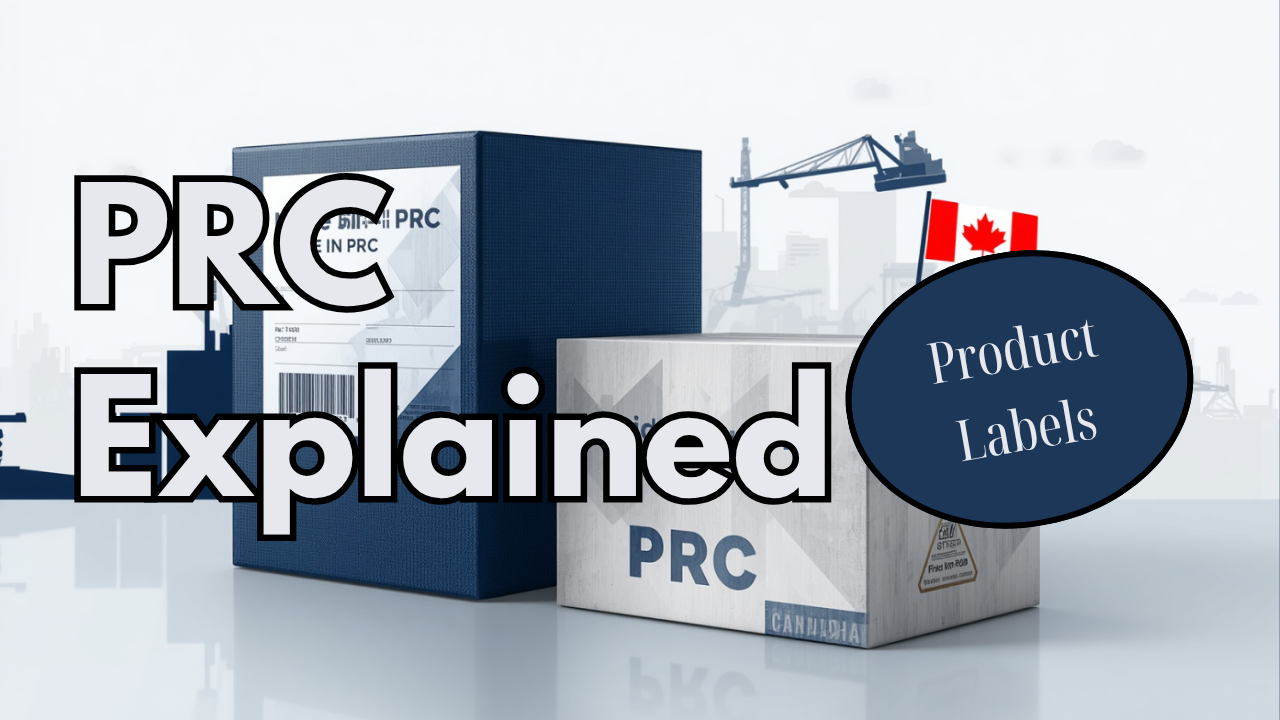
Some product labels and customs documents say "Made in PRC" instead of the more familiar "Made in China." Both mean exactly the same thing. Manufacturers and compliance teams sometimes default to "PRC" because it's the legally precise term used in trade documentation, and it avoids any ambiguity with Hong Kong, Macau, or Taiwan, which have distinct customs and trade statuses even though they're geographically or politically linked to China.
For Canadian importers, this distinction actually matters. Hong Kong and Macau are Special Administrative Regions with their own trade arrangements, and goods manufactured there can be treated differently for tariff and country-of-origin purposes than goods from mainland China (the PRC). If your certificate of origin says "PRC," your goods are considered mainland Chinese in origin — not Hong Kong or Macau — which affects how CBSA classifies and assesses your shipment.
If you're sourcing products from China, "PRC" will most commonly show up in three places: the certificate of origin, the country-of-origin marking required on the product or packaging itself, and customs declarations filed at the Canadian border. Getting the country-of-origin designation right on all three isn't optional — it's a legal requirement.
The certificate of origin is the document your supplier or freight forwarder provides confirming where the goods were actually manufactured. This feeds directly into how the Canada Border Services Agency assesses duties and applies any trade agreements or anti-dumping measures. If you're unfamiliar with how this process works end to end, our CARM and CBSA guide for Canadian importers walks through what CBSA requires at each stage.
Country-of-origin marking on the product itself (or its retail packaging) is a separate requirement from the certificate of origin, and Canadian regulations are specific about what's acceptable. "Made in PRC" and "Made in China" are both generally accepted, but the marking needs to be permanent, legible, and in a location a typical consumer would see before purchase.
One mistake we see often with newer importers is confusing PRC (People's Republic of China — mainland China) with ROC (Republic of China — Taiwan). These are two entirely separate customs jurisdictions with different trade agreements, tariff schedules, and — increasingly — different geopolitical trade considerations for Canadian importers.
If your supplier is actually manufacturing in Taiwan but your paperwork says PRC (or vice versa), you risk a customs hold, incorrect duty assessment, or a compliance flag that delays your shipment at the Canadian border. Always confirm which jurisdiction your goods are actually produced in, and make sure your certificate of origin, product labels, and customs paperwork all agree.
With ongoing shifts in Canada-China trade relations and ordinary tariff reviews affecting specific product categories, having your country-of-origin documentation exactly right has become more important, not less. An incorrect or inconsistent PRC designation on your paperwork can trigger additional scrutiny even when your product itself is fully compliant. If you're sourcing from multiple countries — say, comparing Vietnam and China as manufacturing bases — getting the country-of-origin paperwork right for each becomes even more important, since misattributing origin between the two can affect your tariff treatment significantly.
This is also where working with an experienced sourcing partner pays off. A good sourcing agent verifies not just the factory's quality standards but also confirms the actual location of manufacture, so the PRC or non-PRC origin on your paperwork accurately reflects reality — not just what a trading company told you.
The People's Republic of China was established in 1949, following the Chinese Civil War, when the Communist Party took control of mainland China. The prior government, the Republic of China, retreated to the island of Taiwan, where it continues to govern under the name "Republic of China" (ROC) to this day. This is the historical root of the PRC/ROC distinction that still shows up on trade documents more than 75 years later.
For most day-to-day purposes, this history doesn't matter — "China" and "PRC" are interchangeable in casual conversation. But in trade, customs, and diplomatic documentation, the formal names carry legal weight, because "China" alone can be ambiguous in a way that "People's Republic of China" or "Republic of China" is not. That's precisely why customs authorities, including the CBSA, use the formal designations rather than the colloquial name.
Once you start looking for it, PRC shows up in more places than just your product labels. Business registration documents for companies incorporated in mainland China will reference the PRC. Legal contracts with Chinese manufacturers, including manufacturing agreements and NDAs, typically specify "the laws of the People's Republic of China" as the governing law — which is worth understanding before you sign anything, since it affects what recourse you'd have in a dispute.
You'll also see PRC referenced in trade statistics, tariff schedules, and government publications from both Canadian and international sources. Statistics Canada, for example, uses "People's Republic of China" as the formal country designation in its trade data, distinct from Hong Kong and Macau, which are tracked separately despite being part of Chinese sovereign territory.
Country-of-origin designation isn't just a labelling formality in Canada — it determines which tariff treatment applies to your goods under the Customs Tariff, whether any trade remedies (like anti-dumping or countervailing duties) apply, and how CBSA calculates the duties owed at the border. Goods correctly identified as PRC-origin are assessed under whatever tariff treatment currently applies to mainland Chinese goods, which can shift with trade policy changes.
This is exactly why accuracy matters more than it might first appear. If a product is actually assembled in Vietnam using Chinese components, for instance, its correct country of origin depends on where the last "substantial transformation" occurred — not simply where the raw materials came from. Getting this determination wrong, in either direction, creates real compliance exposure. Our guide on importing from China to Canada covers how country-of-origin rules interact with the rest of your import documentation in more detail.
Before you place a large order, confirm three things: that your supplier's factory is actually located where they say it is, that your certificate of origin correctly states PRC (or the correct jurisdiction) for every SKU in your shipment, and that your product's country-of-origin marking matches your customs paperwork exactly. Mismatches between these three documents are one of the most common reasons Canadian shipments get held at the border for review.
If you're setting up an import process for the first time, our complete guide to importing from China to Canada covers documentation requirements in more depth, and pairs well with understanding what PRC does and doesn't mean on your paperwork.
It's also worth double-checking these details before your goods ship, rather than after they've already left the factory. Once a shipment is in transit, correcting a certificate of origin or a labelling error typically means delays at the Canadian border while amended paperwork is filed — and in some cases, additional inspection or a hold that can add days or weeks to your delivery timeline. A quick review of your supplier's paperwork before production even starts is far cheaper than a correction after the fact.
A growing number of Canadian importers are now sourcing components from one country and final assembly from another — a common pattern as businesses diversify away from single-country supply chains. In these cases, the PRC designation isn't automatic just because some inputs came from mainland China. Origin is generally determined by where the last substantial transformation of the product occurred, which means a product assembled in Vietnam using Chinese fabric or components might correctly carry a Vietnamese origin designation, not PRC, depending on the specifics of the transformation involved.
This distinction has become more consequential as more Canadian brands weigh Vietnam against China for at least part of their production. Getting the origin determination right isn't just a compliance exercise — it can directly affect which tariff schedule applies to your shipment, and in some cases, whether preferential trade agreement rates are available to you at all.
What does PRC mean on a product label?
PRC stands for the People's Republic of China. "Made in PRC" means the product was manufactured in mainland China, and is equivalent to "Made in China" for labelling and customs purposes.
Is PRC the same as China?
Yes. The People's Republic of China (PRC) is the official name of the country commonly referred to as China. PRC is the more formal, legally precise term used in trade and government documentation.
What's the difference between PRC and ROC?
PRC refers to mainland China. ROC (Republic of China) refers to Taiwan. They are separate customs and trade jurisdictions, and confusing the two on import paperwork can cause tariff and compliance errors.
Does "Made in PRC" affect my customs duties in Canada?
It can. Country-of-origin designation determines which tariffs, trade agreements, and any applicable anti-dumping measures apply to your shipment. An incorrect PRC designation can lead to misapplied duties or delays at the border.
Do Hong Kong and Macau count as PRC on customs paperwork?
No. Hong Kong and Macau are Special Administrative Regions with distinct trade and customs statuses, even though they are part of China. Goods from these regions should not be labelled as PRC-origin unless they were actually manufactured on the mainland.
Getting country-of-origin documentation right isn't just a paperwork formality — it directly affects your duties, your customs clearance timeline, and your compliance risk. Epic Sourcing Canada verifies exactly where your supplier manufactures, makes sure your certificates of origin and product labelling are consistent, and helps you avoid the PRC/ROC mix-ups that hold up shipments at the border. If you want a sourcing partner who handles this correctly from day one, reach out to our team and we'll walk you through it.